

Costa Rica is working on a national project to generate electricity from biomass derived from agricultural and agro-industrial waste streams. This includes sugarcane bagasse, waste from coffee, palm oil, and wood production, and other organic materials. With this initiative, the country aims to strengthen its energy security and reduce its dependence on fossil fuels.
The project is being prepared by Costa Rica’s Ministry of Environment and Energy (MINAE) in collaboration with the Inter-American Institute for Cooperation on Agriculture (IICA). The intention is to submit the proposal to the Green Climate Fund, the largest international financing mechanism for climate-resilient projects.
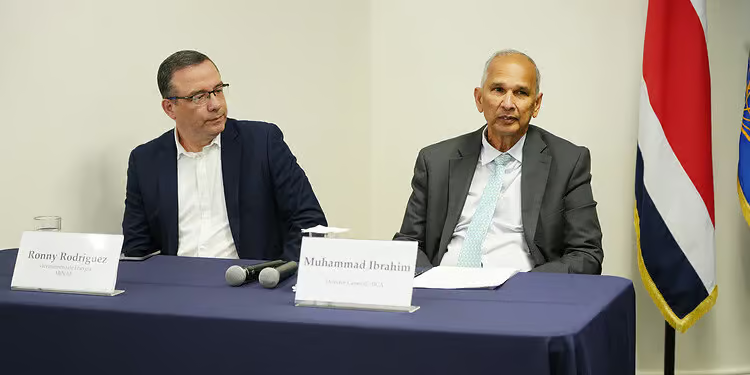
According to IICA Director General Muhammad Ibrahim, Costa Rica offers significant opportunities to utilize waste streams from the agri-food sector more efficiently. In a period of fluctuating fuel prices and rising production costs, he believes it is essential to further develop biomass solutions. This can increase both energy security and the resilience of the agricultural sector.
The project, titled Development of adaptive capacities and electricity generation with biomass in Costa Rica through integrated waste management in the agri-food industry, focuses on a different approach to agricultural residues. Instead of viewing these materials as waste, they should be used as raw materials for renewable energy and the circular economy.
Ibrahim states that the initiative follows an integrated approach, connecting agriculture, energy, environment, and health. According to him, the project aligns with IICA’s new medium-term plan for 2026-2030. This involves collaborating with governments, the private sector, and other stakeholders to support producers with innovation, technical guidance, and concrete solutions for environmental issues.
For the Costa Rican Ministry of Energy, the project comes at a strategic moment. According to authorities, the country is increasingly facing periods of water stress, which affects hydroelectric production. Deputy Minister of Energy Ronny Rodríguez Chaves states that biomass can become an important supplement to the national electricity grid.
According to Rodríguez, power generation from biomass makes it possible to utilize agricultural by-products, broaden the energy mix, and reduce dependence on fossil fuels, especially during times of environmental pressure. He emphasizes that the collaboration with IICA is intended to prepare a technically well-founded project that fits within national goals for decarbonization and sustainable development.
The plan provides for the implementation of pilot projects for electricity generation from biomass, with a combined installed capacity of approximately 30 megawatts. These will use agricultural waste streams that currently have little economic value or whose processing involves high costs.
The initiators expect that the project can replace part of the thermal energy production, reduce polluting emissions, and strengthen circular economy practices within the agri-food industry. Additionally, it could yield economic and environmental benefits for rural areas.
It is estimated that more than 27,000 people can benefit directly from the project. Indirectly, the initiative could benefit over 1.6 million people through improved energy security, stronger productive resilience, and more sustainable development.
Other important national institutions are also involved in the preparation of the project, including the Costa Rican Electricity Institute (ICE), the Ministry of Agriculture and Livestock, producer organizations, and research centers. In doing so, the parties involved want to ensure that the proposal is technically feasible and aligns with Costa Rica’s national priorities.
The project fits within Costa Rica’s nationally determined climate goals and the Green Climate Fund’s country program. With this, the country once again underscores its ambition to transition to a resilient, low-emission energy system using innovative solutions and its own natural resources.

