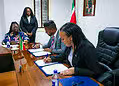




’s Lands Hospitaal needs more than SRD 9 million to purchase medical equipment to improve care for premature babies and children. The amount must be raised through the annual Su Aid Gi Wan Anu fundraising campaign, which starts on Monday, 2 November and runs until 20 December 2026. The equipment is needed not only to strengthen existing care, but also to address shortages of backup equipment.
Pediatrician Laurindo Kloof made clear during the launch of the project that the medical equipment is intended for the Neonatal High Care Unit, the Pediatric High Care Unit and the children’s outpatient clinic. These departments treat, among others, prematurely born babies and children who require intensive medical care.
According to Kloof, the hospital is doing everything possible to continue providing the necessary care despite limited resources. The purchase of new equipment is expected to improve the quality and continuity of treatments.
Shortage of nurses remains a challenge
In addition to the lack of medical equipment, the hospital is facing a shortage of nurses. According to Kloof, the departure of healthcare staff abroad has taken a heavy toll on staffing levels in recent years.
The hospital is trying to counter this development by investing in training, retaining experienced staff and recruiting new nurses. Various efforts have been made for this purpose over the past two years.
Kloof describes daily practice as a combination of hard work and praying to keep healthcare services at the required level under difficult circumstances.
Once the new equipment becomes available, nurses will be trained to use it properly. Following the order, it may take about six weeks before the devices are delivered.
Failure of medical equipment poses risk to patient care
Medical director Soenita Nannan Panday points in particular to the shortage of backup equipment. Although the hospital has generators to cope with power outages, the failure of medical devices poses a greater problem, according to her.
When a device breaks down, a replacement is not always immediately available. This can have serious consequences for patients who depend on specialised medical support.
Turning to other hospitals does not always offer a solution either, as other healthcare institutions also face limited equipment and a shortage of backup facilities.
The planned purchase should therefore not only expand existing capacity, but also ensure sufficient backup equipment to better safeguard continuity of care.
Local suppliers responsible for maintenance
The hospital plans to purchase the equipment from local suppliers it already works with. In addition to delivery, these companies will also handle installation, maintenance and any repairs.
The suppliers will also provide training to nurses and other involved healthcare staff. In this way, the hospital aims to ensure that the devices are used safely and effectively.
Fundraising campaign runs until 20 December
Su Aid chairman Giwani Zeggen indicated that the fundraising campaign will begin on Monday, 2 November and conclude on 20 December. The accompanying radio broadcasts via Radio 10 will also start earlier this year.
Although the campaign ends in December, the final amount raised will not be known immediately. According to Zeggen, administrative procedures may take some time.
It is expected that by the end of January or in mid-February 2027, it will become clear how much money has actually been raised and what amount will be available for the purchase of the medical equipment.
Through the fundraising campaign, Su Aid hopes to raise the required more than SRD 9 million, so that ’s Lands Hospitaal can further improve care for premature babies and children.