The draft Food Act 2026 raises questions at several ministries about the division of powers, feasibility and the consequences for existing government agencies.
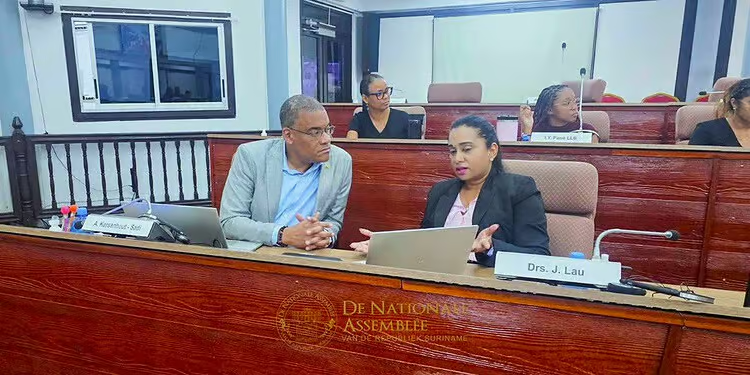
During a meeting with the Commissie van Rapporteurs (CvR) of De Nationale Assemblée (DNA, Suriname’s parliament) on Monday, October 26, three ministers raised various bottlenecks in the bill. In particular, the possible overlap of tasks between government institutions and the transfer of inspectors are causing discussion.
The committee discussed the bill with Minister André Misiekaba of Volksgezondheid, Welzijn en Arbeid, Minister Mike Noersaliem of Landbouw, Veeteelt en Visserij, and Minister Andrew Baasaron of Economische Zaken, Ondernemerschap en Technologische Innovatie. Technical experts from the three ministries also took part in the meeting.
The draft act is intended to strengthen food safety in Suriname by establishing clear rules on the quality, safety and inspection of foodstuffs. Before the proposal is considered in a public meeting of parliament, however, several issues must still be clarified, according to the ministers involved.
Uncertainty over powers for food inspection
Minister Baasaron pointed to possible overlaps between the powers of the proposed Nationaal Instituut voor Voedselveiligheid (NIVS) and existing institutions.
Under the bill, the NIVS would, among other things, become responsible for technical regulations concerning food labelling. However, the Surinaams Standaarden Bureau (SSB) currently already has powers in this area.
This creates uncertainty over which institution will ultimately be responsible for setting and enforcing certain regulations. According to the discussion, a clear division of tasks is necessary to prevent problems in implementing the law.
Misiekaba fears staff shortages at BOG
Minister Misiekaba also raised reservations about parts of the bill. His objections include the planned transfer of environmental inspectors from the Bureau voor Openbare Gezondheidszorg (BOG) to the new food safety institute.
According to the minister, these inspectors are currently deployed for several duties and their tasks are not limited exclusively to inspections. If they are transferred to the NIVS, this could affect staffing levels and the performance of other duties within the BOG.
Misiekaba also called for attention to the description of the objectives and powers of the proposed consultative body. According to him, these are formulated too broadly, making it insufficiently clear which responsibilities the body will receive.
Questions about private-sector influence
The involvement of the private sector in decision-making on food safety was also discussed during the meeting.
Committee members Cheryl Dijksteel and Silvana Afonsoewa asked questions about the influence that business representatives would have within the proposed council.
Committee member Ronny Asabina also wanted to know how cooperation and coordination between the three ministries involved would be organised.
Although the bill provides for consultations between the responsible ministers, it emerged during the committee meeting that such joint consultations had not yet taken place.
Parliament wants clarity before public consideration
At the start of the meeting, committee chair Raymond Sapoen gave an overview of the comments and recommendations submitted by various stakeholders on the bill in recent years.
The discussion with the ministers is part of preparations for the further parliamentary consideration of the draft Food Act 2026.
In addition to Sapoen, committee members Cheryl Dijksteel, Silvana Afonsoewa, Ronny Asabina, Wedprekash Joeloemsingh and Mohamed Fatemahomed were present. Ingrid Karta-Bink, Ameerani Jarbandhan and Ebu Jones attended the meeting as observers.
Further consideration must clarify how the identified overlaps, unclear powers and practical implementation problems will be addressed.
The new law is intended to strengthen oversight of foodstuffs in Suriname. However, the discussion in parliament shows that questions still remain about the organisation of oversight and its consequences for existing government services.