





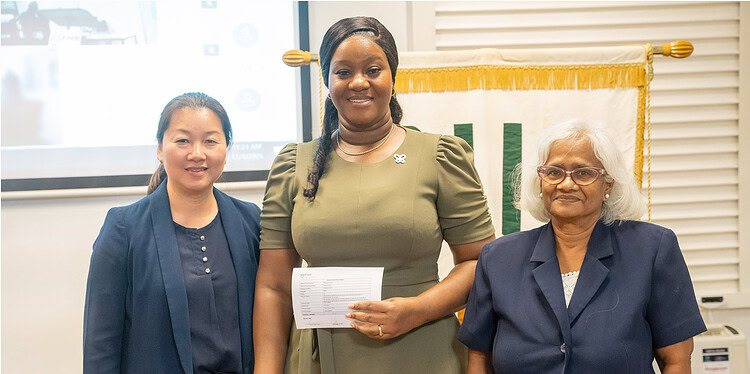


The study, entitled ‘Governance Performance and Local Development Outcomes in Brokopondo, Suriname’, focuses on the effects of decentralisation reforms between 2015 and 2025. Huur examined the extent to which these reforms have contributed to better local governance, greater citizen participation and improved public service delivery in the district.
Lack of resources hampers decentralisation
The research findings show that the transfer of powers to local governing bodies does not automatically lead to greater independence or better service delivery. According to Huur, limited financial resources, insufficient administrative capacity and political influences in particular form major obstacles to effective decentralisation.
“Decentralisation does not automatically mean that local authorities also gain more control,” the minister stated during her presentation.
According to Huur, local governing bodies should not only be granted formal powers, but should also have sufficient financial resources, expertise and administrative autonomy to actually carry out their responsibilities.
Improvements dependent on external support
In her research, Huur also paid attention to citizens’ involvement in decision-making and the quality of public facilities in Brokopondo.
Although improvements are visible in certain areas, including education and healthcare, the research findings indicate that these are often partly dependent on financial support from donors and cooperation with the private sector.
According to the study, this dependency underlines the need to structurally strengthen local governing institutions so that improvements in service delivery can be continued sustainably.
More autonomy and citizen involvement needed
Based on her research results, Huur advocates predictable funding for the districts and strengthening administrative capacity at the local level. She also recommends involving citizens and traditional authorities more explicitly in decision-making processes.
“Decentralisation only becomes meaningful when local authorities have the resources, capacity and autonomy to actually act and communities experience improvements in public service delivery,” the minister said.
With her research, Huur once again draws attention to the challenges surrounding decentralisation. The findings are also relevant to the policy of the ministerie van Regionale Ontwikkeling, which is responsible for the further development and strengthening of local governance in Suriname. The ministry congratulated the minister on obtaining her master’s degree.