


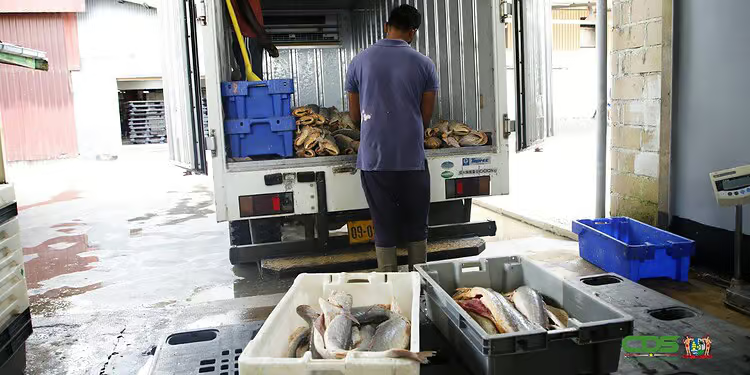
Suriname American Industries Limited (SAIL) intends to increase production in the coming years and export more fish and seafood products itself. The company is looking at markets in the Caribbean, Miami and Europe. According to director Ifuel Alberg, SAIL is currently in a growth phase and confidence within the company has been restored.
Alberg told the Communicatie Dienst Suriname (CDS, Suriname’s government communications service) on Tuesday, September 22, 2026, that clarity about the company’s future has contributed to greater confidence within the organisation.
“Because there is no sale of the company, there is once again some confidence that we can move forward,” the director said.
According to him, SAIL receives no government subsidy and must generate its own income. To become financially stronger, the company mainly aims to achieve greater volume. This involves not only shrimp, but also fish and other seafood products.
“Everything depends on volume,” Alberg states.
Own exports
An important part of the growth strategy is establishing and expanding its own export activities. SAIL is exploring sales opportunities in, among others, the Caribbean, the United States and Europe.
At the same time, the company is trying to strengthen its position on the Surinamese market. According to Alberg, SAIL has its own quality department that oversees, among other things, hygiene, food safety and product processing.
“SAIL’s quality is very high. I think we need to boost that locally,” he says.
Cooperation with Venezuela
Regional cooperation also plays a role in the company’s plans. According to SAIL, Venezuelan fishing vessels make use of the company’s facilities. This takes place in cooperation with Deep Sea Atlantic and in coordination with the Venezuelan embassy.
During her official visit to Suriname on September 11, Venezuelan President Delcy Rodríguez also visited Venezuelan fishers at SAIL’s port. During that visit, Suriname and Venezuela discussed, among other things, further cooperation in the areas of fisheries, agriculture, energy and trade. According to Alberg, the visit underscores the importance of regional cooperation for the company.
Outdated installations
Although SAIL has growth plans, investments are needed to further modernise the company, according to the director. Part of the current installations is outdated and must be upgraded to make production more efficient and financially sustainable.
For the 2026-2030 period, several scenarios and a rescue plan have been presented to the shareholder. A special team is holding discussions on the matter.
“We are well on our way,” Alberg says.
He was appointed director of SAIL in January 2026. Upon taking office, he emphasised the redevelopment of the company, with the aim of offering both the business and its employees better future prospects.

