





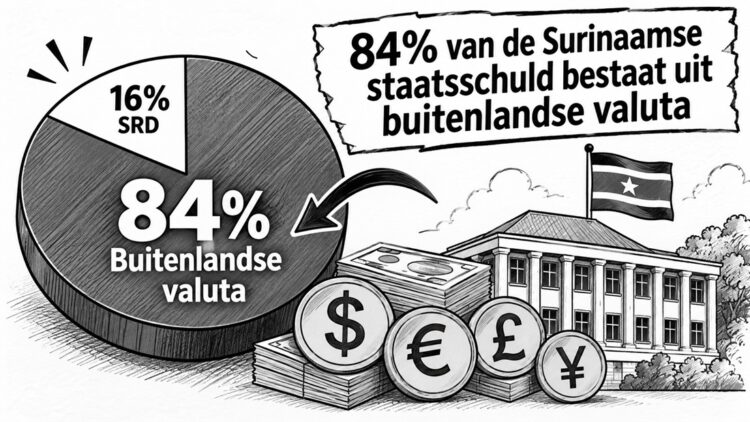


Suriname remains vulnerable to fluctuations in the foreign exchange market despite the improvement in its creditworthiness. According to international credit rating agency S&P Global Ratings, about 84 percent of total government debt is denominated in foreign currencies. As a result, changes in the exchange rate can have significant consequences for the government’s debt burden, even when the economic outlook improves.
The warning is included in the report of November 9, 2026, in which S&P upgraded Suriname’s long-term credit rating from CCC+ to B-, with a stable outlook.
The credit rating agency expects strong revenues from the gold sector and future oil production to significantly strengthen Suriname’s financial position.
At the same time, the composition of public debt and dependence on foreign financing remain important points of attention.
Public debt sensitive to exchange rates
According to S&P, 84 percent of total government debt is denominated in foreign currencies. This means that a weakening of the Surinamese dollar can increase the value of these debts when converted into local currency. The government may also need more Surinamese dollars at a higher exchange rate to pay interest and principal in foreign currencies.
This leaves the government’s financial position sensitive to developments in the foreign exchange market. The credit rating agency also points to the limited size of the domestic debt market. According to S&P, about 97 percent of commercial government debt is held by non-residents. As a result, external financing occupies an important place within Suriname’s debt structure.
Oil exports must improve external position
S&P expects the start of large-scale offshore oil production from 2028 to bring an important change to Suriname’s external financial position. Revenues from oil exports are expected to contribute to a significant increase in export earnings.
For 2026 and 2027, S&P still expects substantial current-account deficits in the balance of payments. According to the credit rating agency, these are expected to be fully financed by foreign direct investment, mainly in connection with the development of the GranMorgu offshore oil project.
From 2028, the sharp increase in oil exports is expected to result in a shift to a current-account surplus. This could significantly improve Suriname’s external debt position.
External debt ratio could decline sharply
According to S&P’s projections, so-called narrow net external debt could decline from 66 percent of current-account receipts in 2025 to about 13 percent in 2029.
This indicator reflects the net external debt position in relation to income from foreign economic transactions, including export revenues.
The expected improvement is mainly linked to the sharp increase in oil exports.
At the same time, S&P emphasizes that Surinamese exports will remain heavily dependent on commodities.
As a result, the external financial position may remain sensitive to changes in international commodity prices and the confidence of foreign investors.
Debt management must be further strengthened
The credit rating agency also points to the need to further improve the management of government debt.
According to S&P, previous payment arrears exposed shortcomings in cooperation between the Bureau voor de Staatsschuld (Public Debt Office), the Ministry of Finance and the Centrale Bank van Suriname (Central Bank of Suriname).
Although the payment arrears have since been resolved, the organisation says it remains necessary to structurally strengthen debt-management capacity.
S&P states that a sustainable improvement in this area could contribute to a further upgrade of Suriname’s creditworthiness.
The expected oil revenues may improve the country’s financial position, but according to the assessment, they do not automatically eliminate all risks associated with the size, composition and management of government debt.