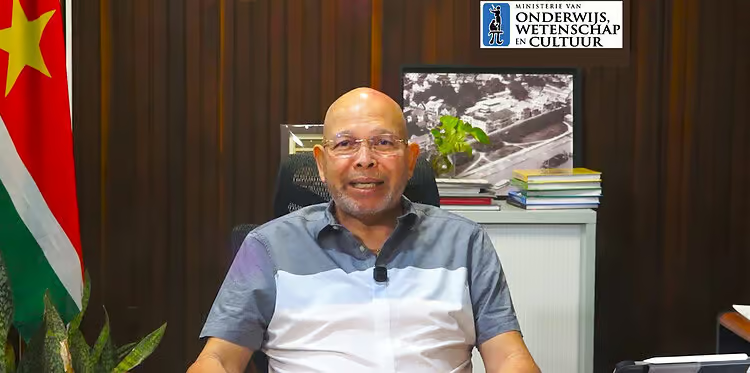
Minister Dirk Currie of Onderwijs, Wetenschap en Cultuur does not believe that the ministry made an error of judgment by allowing the school year to begin on 1 October, despite concerns about the shortage of teachers. According to him, the school start was deliberately chosen after the issue had been extensively discussed with the education unions.
The minister was responding to the question of whether it was responsible to send pupils to school while some schools may have insufficient teachers to provide supervision. The unions have warned, among other things, that in the event of incidents or fights, insufficient staff may be available to intervene.
Currie says this issue was raised during consultations with the unions.
“When we talk about being sensible, it is not only the unions that are sensible. The ministry is also sensible, and we made a sensible decision by calling on pupils to go to school on 1 October,” the minister said.
According to Currie, the ministry and the unions left the consultations with the clear conclusion that the school year would begin on 1 October. He therefore had not expected some of the unions subsequently to call on parents to keep their children at home.
‘Everyone has their own responsibility’
The minister stressed that the various parties within education have their own responsibilities. According to him, trade unions must stand up for the interests and working conditions of teachers, while the government must also take account of the entire public sector and the State’s financial capacity.
Currie pointed out that the government has held several lengthy discussions with the unions in recent months on working conditions and other bottlenecks.
According to him, consultations were held last Thursday and Friday, and the government and unions also met on Monday from approximately 11 a.m. to 5:30 p.m., with President Jennifer Geerlings-Simons also present.
“We cannot say that we have not devoted time or given attention to the wishes,” Currie said.
At the same time, according to him, the government must take into account the consequences for other groups within the public sector when considering possible financial improvements for teachers. According to the minister, the government employs approximately 50,000 people.
According to Currie, the Minister of Finance is therefore involved in such discussions to ensure that any measures fit within the government’s financial capacity.
No complete picture of first school day yet
On Thursday, Currie was still unable to indicate how many schools had actually started with pupils. He instructed school principals to report on this.
By the end of Thursday or Friday, a clearer picture is expected to emerge of the attendance of both pupils and teachers on the first school day.
Teachers were present at several schools on Thursday, but many pupils stayed home. Currie partly attributes this to the call by some of the trade unions.
He stressed that not all education unions supported the call to parents. According to him, this caused additional confusion because teachers within a single school are sometimes affiliated with different unions.
Call to parents: send children to school
Currie explicitly calls on parents to send their children to school on Friday.
According to the minister, it ultimately concerns the future of young people, and every missed school day can have consequences for their development.
“We still face challenges, but we are doing everything possible to have as many teachers as possible in front of the classroom,” Currie said.
The ministry first wants to await reports from all school principals to determine the extent of the actual teacher shortage and at which schools additional measures are needed.