





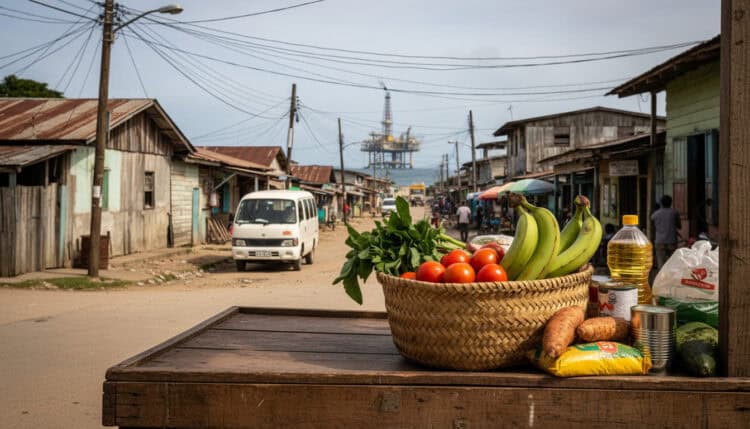


According to opposition parliamentarian Sharma Solomon, Guyana’s rapidly growing oil economy is still not sufficiently translating into lower costs for ordinary households.
Despite billions in oil revenues and extensive government investments, groceries, transport and other daily expenses continue to weigh heavily on the budgets of many Guyanese. Solomon calls on the government not only to provide temporary financial support, but also to structurally address the causes of high prices.
This was reported by the Guyanese newspaper Kaieteur News on Saturday, November 7. Solomon, a member of parliament for the opposition coalition A Partnership for National Unity (APNU), says that growing national budgets have not yet brought a convincing improvement in purchasing power.
Food prices rise by 6.7 percent
Solomon refers to the mid-year figures for 2026. They show that food prices rose by 6.7 percent between the end of 2025 and June 2026. Overall consumer prices increased by 4.4 percent over the same period. The figures are confirmed by the Guyanese government information service.
At the same time, the agriculture, forestry and fisheries sector contracted by 0.5 percent in the first six months of this year. The other crops subsector recorded a decline of 6.4 percent, while vegetable production fell by 4.2 percent. According to the government, prolonged, above-average rainfall played an important role.
According to the mid-year report, approximately 40.8 billion Guyanese dollars was spent on the agricultural sector in the first half of 2026. Solomon wants to know what concrete effect those investments had on production, distribution and ultimately the prices consumers pay.
Oil growth versus daily expenses
The concerns stand in sharp contrast to Guyana’s economic growth. According to official figures, the economy grew by 33.3 percent in the first half of 2026, while the non-oil sector expanded by 10.1 percent. The Guyanese government expects nearly US$6.5 billion in revenue from the petroleum sector for all of 2026.
Solomon believes these revenues should be used more extensively to permanently reduce the cost of living. He advocates, among other things, better storage facilities for agricultural products, reliable transport links between farmers and markets, improved drainage and irrigation, and a better organised food supply.
Government points to support measures
The government of President Irfaan Ali has previously pointed to several measures to support households and producers. These include cash grants of 100,000 Guyanese dollars, agricultural subsidies and measures to limit the cost of electricity, water and fuel. The government is also working on farmers’ markets where producers can sell their products more directly to consumers.
According to the Guyanese government, prices are also affected by imported inflation, higher demand, retail profit margins and unfavourable weather conditions. The government states that its measures have helped prevent larger price increases.
Solomon considers that explanation insufficient. He asks the government to demonstrate measurably to what extent the billions in spending have actually resulted in more affordable food, more efficient agriculture and greater purchasing power. According to him, Guyana’s prosperity should not be measured solely by oil production and economic growth figures, but also by families’ financial position.
Sources: Kaieteur News; Guyanese government information service (mid-year report 2026).