








Indigenous communities in Suriname are receiving support in combating Cassava Witches’ Broom Disease (CWBD), a plant disease that threatens cassava cultivation and, consequently, families’ food security and income. The government of New Zealand is making 50,000 New Zealand dollars (approximately US$28,500) available for this purpose.
The project is being implemented by the United Nations Development Programme (UNDP) in Suriname. Indigenous women in particular are being supported in identifying, monitoring, preventing and controlling the disease.
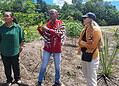
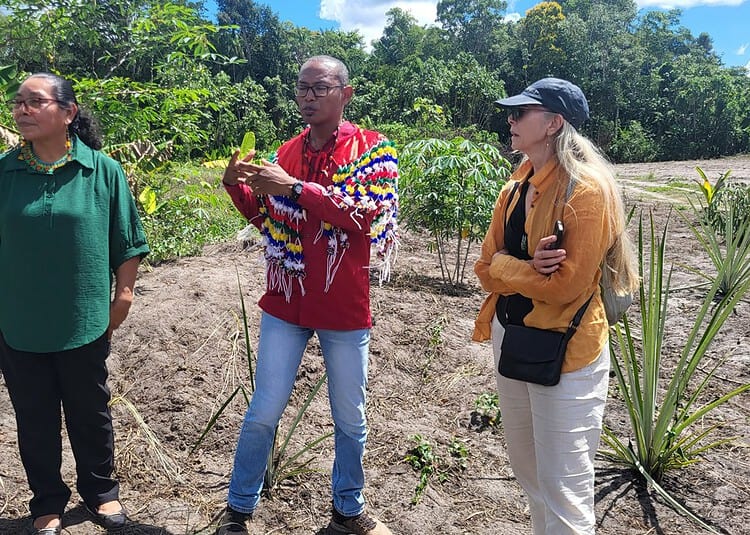
As part of Diplomatic Week, diplomatic representatives, including New Zealand Ambassador Linda Te Puni, visited Matta and Philippusdorp in Para district. During the field visit, they were briefed on measures to prevent the spread of the disease. They also viewed healthy and affected cassava plants.
Knowledge exchange with Brazil
Representatives of Matta and Philippusdorp had earlier taken part in a knowledge exchange in Oiapoque, Brazil. There, they learned from Indigenous communities that are also dealing with the plant disease.
Mardo Aroepa, a resident of Konomerume (Donderkamp), says that the knowledge gained will be shared with other farmers. Village head Gladys Kabelefodi of Philipus Shikwabana points out that there is still no cure for the disease, but that tolerant cassava varieties and adapted cultivation methods can help. She also emphasises the importance of documenting traditional knowledge.
Food security and income
For Indigenous communities, cassava is not only an important food source, but also a source of income and part of traditional food systems. The project therefore also provides for safer planting and cultivation methods, educational materials and further cooperation between communities in Suriname and Brazil.
According to Berdi Berdiyev, deputy representative of UNDP Suriname, the combination of traditional knowledge, science and regional experience can contribute to a sustainable approach to the cassava disease.