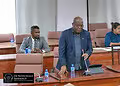








Simons described corruption as a serious social problem that not only causes financial harm to the state, but also has direct consequences for citizens. “But often a disadvantage to fellow citizens,” the president said. According to her, society experiences the negative consequences of corrupt practices on a daily basis.
“Corruption is something we are really working on,” the head of state stressed. The government is focusing, among other things, on developing systems intended to limit the scope for arbitrariness, abuse and corruption within government processes.
Housing Fund as an example
As a concrete example, Simons referred to the Wet Nationaal Woningbouwfonds. According to her, this law contains strict procedures aimed at preventing corruption in the processing of applications as much as possible.
“It is very strictly regulated by law,” the president stated. Citizens who submit an application must be able to track how their application is being processed. In addition, according to Simons, the fund is legally required to process applications in the correct order.
With this approach, the government aims to prevent applications from being favoured outside regular procedures. “Because the fund is obliged to process the applications one after another, and with that we have made an effort to give society confidence,” Simons said.
Digitalisation must limit arbitrariness
In addition to stricter legal procedures, the president sees digitalisation as an important instrument in the fight against corruption. By better organising government processes and making them digitally accessible, the current disorder within parts of the public administration must gradually be reduced.
According to Simons, a better organised and digitalised public administration can make certain forms of corruption more difficult. It must also become clearer to citizens how applications and other administrative processes proceed.
The president expects the modernisation of the government to deliver gradual improvements over the next two to three years. According to her, this is not a change that can be achieved overnight.
Corruption remains a major challenge
Simons acknowledges that corruption is a persistent problem faced not only by Suriname, but also by other countries. She stressed that her government wants to make serious efforts to reduce it.
For the time being, the emphasis is on strengthening systems, improving government organisation and limiting opportunities for abuse. No concrete figures on the scale of corruption or measurable targets for the coming years were mentioned in the cited statements.