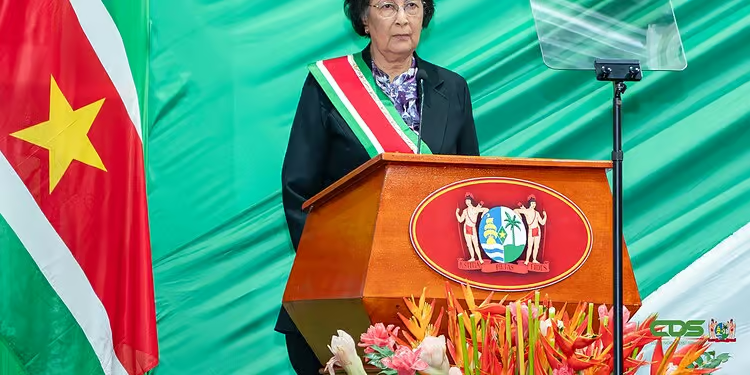
The government intends to begin implementing the BIO-SWEET project in mid-2027, which is to provide 26 communities with electricity and drinking water. President Jennifer Simons announced this during her annual address on Wednesday, September 30. The project is part of the ambition to provide everyone with access to electricity by 2030.
“We will begin implementing the BIO-SWEET project in mid-2027, which will provide 26 communities with electricity and drinking water,” Simons stated in De Nationale Assemblée (Suriname’s parliament).
The annual address does not state which communities fall under the project, how many residents will be reached or when the facilities must be completed. The costs and financing are also not explained. Mid-2027 is the planned start of implementation, not the announced completion date.
Expansion of electricity supply
In addition to the BIO-SWEET project, the government wants to extend the power grid to East Suriname. According to Simons, sustainable electricity generation was expanded over the past year with three new solar power plants. Distribution networks were also improved and pilot projects involving small-scale hydropower systems were carried out.
The president further reported that the government recently approved the Electricity Sector Plan. The foundation for this was laid through the Energie Autoriteit Suriname (Suriname Energy Authority).
The measures are intended to contribute to a reliable, affordable and sustainable energy supply. The government wants to diversify the national energy supply by making greater use of gas and solar energy alongside heavy oil.
Investments against power outages
Simons also announced necessary investments to reduce planned power outages, or load shedding, and meet the future growth in energy demand.
The annual address contains no separate timetable for ending load shedding. Nor does it indicate which investments will be implemented first.
Greater access to drinking water
The BIO-SWEET project aligns with the broader effort to expand the drinking water supply. “Clean and safe water is not a luxury and every Surinamese must have access to reliable, safe and affordable drinking water,” Simons stressed.
The strategic water plan must increase drinking water coverage towards 2034. For Commewijne, the government cites an increase from 35 to 95 percent. In Brokopondo, the target is 90 percent, while coverage in Sipaliwini must grow from 8 to 50 percent.
This includes decentralised drinking water facilities, new water production centres in Para-West and expansions in Wanica and Nickerie. The government also wants to address water losses and seek financing for the replacement of ageing water pipes.
The start of BIO-SWEET in mid-2027 is, for now, a plan. Further elaboration must clarify which communities will gain access to the announced facilities and when.
Source: annual address for the 2027 service year, pages 31–32.