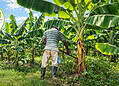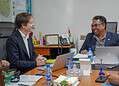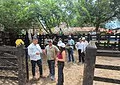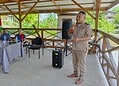


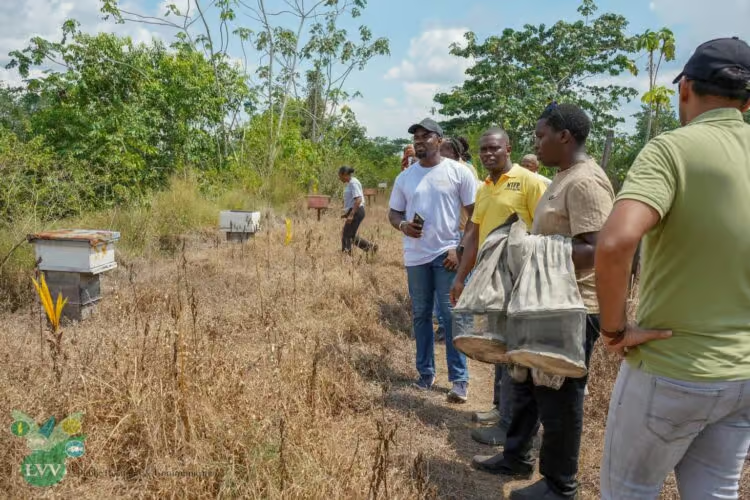


A delegation of seven beekeepers from Dominica visited several beekeeping businesses in Wanica and Commewijne on Monday, November 9, 2026. During the working visits, the visitors and Surinamese beekeepers exchanged knowledge and experiences on honey production, beekeeping techniques and entrepreneurship. Both parties see opportunities to further expand cooperation within the Caribbean beekeeping sector.
The knowledge exchange was organised by the Food and Agriculture Organization of the United Nations (FAO), in collaboration with the Ministry of Agriculture, Livestock and Fisheries (LVV). The activity took place within the Gender-responsive Climate-smart Agriculture and Food Systems in the Caribbean (GCAF) project, which is funded by Global Affairs Canada.
The delegation from Dominica represented the National Beekeepers Cooperative Society Ltd. and was led by chairman Kevin James. The beekeepers were in Suriname to participate in the regional Honey Fair. The additional business visits gave them the opportunity to become acquainted with Surinamese beekeeping outside the traditional honey production area of Coronie as well.
Surinamese beekeepers share practical experience
The first working visit took place at BeeMaster Tini in Wanica. There, the visitors were received by Roy Tini, who is also chairman of the Surinamese honey cluster.
Tini explained local beekeeping, the management of bee colonies and honey processing. He stressed the importance of cooperation and knowledge exchange among beekeepers from different Caribbean countries.
The delegation then visited Danny’s Beekeeping in Commewijne. There, the visitors met young entrepreneur Dhanesh Chittu, who has been active in beekeeping for more than two years.
The beekeepers from Dominica showed particular interest in the development of his business. During a tasting, they noted similarities between the taste of Surinamese honey and honey from their own country.
According to the organisers, the visit highlights the opportunities beekeeping offers young entrepreneurs and the importance of practice-oriented guidance.
Beekeepers face similar challenges
Various techniques were discussed during the talks, including keeping European and Africanised honey bees, queen breeding, and catching and managing natural bee swarms.
Despite differences in working methods, beekeepers from both countries appear to face largely the same challenges. The availability of suitable land, specialised equipment and access to markets are particularly important concerns.
Competition from imported honey and safeguarding product quality were also discussed. Although there is considerable demand for honey, it remains important for local producers to strengthen their market position.
Petra van Dams, GCAF contact person at LVV, indicated that the ministry is paying attention to the availability of suitable locations for beekeeping. Coordination on this is taking place with the responsible land affairs authorities.
Beekeeping gaining interest in Suriname
According to Prithvi K. Jairam, national project coordinator of GCAF in Suriname, interest in beekeeping is growing in various parts of the country.
Although Coronie is traditionally known as an important area for honey production, initiatives are now also emerging in Wanica, Commewijne and the interior.
Within the GCAF project, beekeeping, alongside protected vegetable cultivation, has been designated as a priority value chain. The programme focuses on strengthening knowledge and skills, applying climate-smart agricultural techniques and increasing the involvement of women and young people.
Work is also being done to improve business cooperation and develop market opportunities for local producers.
Possible return visit to Dominica
Delegation leader Kevin James expressed his appreciation after the event for the reception and the practical experience gained. According to him, the exchange offers starting points for further technical and business cooperation between the beekeeping sectors of Suriname and Dominica.
The visitors also proposed receiving Surinamese beekeepers in Dominica in the future. During such a return visit, both countries can further exchange experiences and explore opportunities to jointly improve the production, processing and marketing of honey.
No specific date for a return visit has yet been announced.
Through the exchange, the organisations involved aim to contribute to stronger regional cooperation and the further professionalisation of beekeeping in the Caribbean.