Suriname wants the G-Zero countries to jointly develop investment-ready projects and use these to specifically approach climate funds, development banks, philanthropic organisations and the private sector.
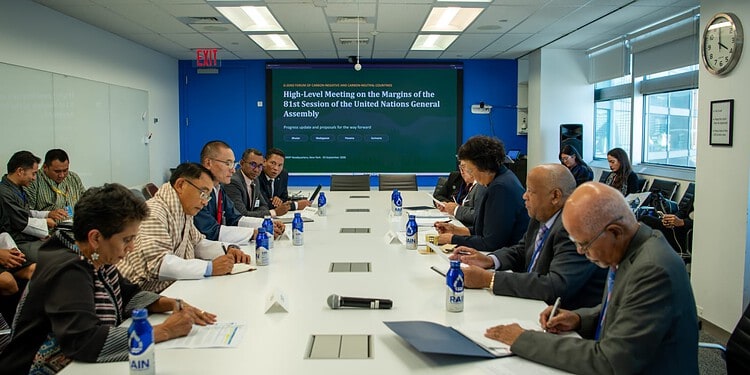
President Jennifer Simons proposed this on Thursday, September 24, during the G-Zero Forum in New York as part of a package of measures intended to move the alliance from political recognition to concrete financing and cooperation.
The G-Zero consists of Suriname, Bhutan, Madagascar and Panama. The partnership brings together countries that are carbon-neutral or carbon-negative and maintain large natural ecosystems. The alliance was launched in November 2024 during COP29 in Baku.
According to Simons, the countries should use their position to make more international financing available for the conservation and sustainable management of forests, biodiversity and other natural resources. Suriname therefore proposes establishing a joint investment pipeline with projects ready to be submitted for financing.
Better demonstrate nature’s value
Another part of the Surinamese proposal is for the G-Zero countries to better map out what they need technically, financially and institutionally. A joint G-Zero Needs and Support Framework should be developed for this purpose.
In addition, Suriname wants the countries to be better able to demonstrate the economic and ecological value represented by their natural ecosystems. To this end, systems for monitoring, reporting and verification, among other things, should be improved. The use of data and so-called Natural Capital Accounting, which incorporates the value of natural resources, should also be strengthened, according to the proposal.
One aim is to make visible the contribution countries make by maintaining ecosystems that are also important for the global climate.
Concrete results towards COP31
Simons further wants a structural mechanism for technical cooperation and knowledge exchange within the alliance. Experts from the four countries should, according to her, work more closely together, share experiences and jointly develop methodologies and capacity.
When attracting larger investments, ecological and social safeguards should be applied at the same time, according to the president. She pointed to participation and a fair distribution of benefits, including for Indigenous peoples, local communities, women and young people.
Suriname wants the G-Zero to be able to present demonstrable results by COP31 at the latest. By then, joint priorities should have been established, contact points designated and a technical cooperation mechanism operational. Financing partners and investment-ready projects must also have been identified, and a roadmap for implementation must be in place.
According to Simons, the cooperation should ultimately not lead to additional bureaucracy, but strengthen and connect existing national systems. Her broader objective is that countries protecting large amounts of natural capital should also be able to derive economic development and greater prosperity for their populations from it.