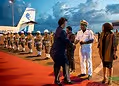
Suriname wants international recognition of carbon-negative and carbon-neutral countries to translate into concrete benefits, including better access to climate finance, technical support and international partnerships. President Jennifer Simons conveyed that message on Thursday during the G-Zero Forum in New York.
According to Simons, it is not enough for countries such as Suriname, Bhutan, Madagascar and Panama to be recognised for their contribution to protecting the global climate. The natural resources these countries protect must also contribute to the development of their own populations, she said.
“We believe the time has come to move from recognition to action,” the president stressed. According to her, the carbon-negative or carbon-neutral status of the G-Zero countries should lead to greater access to financing, technical support, knowledge exchange and meaningful international partnerships.
Natural wealth as a global interest
The G-Zero alliance consists of Suriname, Bhutan, Madagascar and Panama, and was launched in November 2024 during the COP29 climate conference in Baku.
Simons described the member countries as guardians of ecosystems and natural resources whose importance extends beyond their own national borders. Forests, rivers, biodiversity and other natural resources make an important contribution to the global fight against climate change, she said.
At the same time, according to the president, these natural resources must also be used to enable the development ambitions of the population. She stated that climate action and economic development cannot therefore be seen separately from one another.
Oil revenues for sustainable sectors
Suriname has committed itself to retaining at least 90 percent of its forest cover. According to Simons, account must also be taken of communities that depend directly on the forest and other natural resources for their livelihoods.
Notably, Suriname is simultaneously on the eve of large-scale offshore oil production. According to Simons, the government wants to use revenues from the future oil and gas sector to invest in sustainable sectors and further diversify the economy.
The aim, she said, is to build an economy that is less vulnerable and more resilient to future shocks. In addition, Suriname is pursuing an energy transition which, according to the president, must be “realistic” and align with national circumstances.
From recognition to concrete cooperation
Simons stated that the four G-Zero countries, despite differences in their national circumstances, share a joint responsibility for protecting important ecosystems.
Suriname therefore wants the partnership to further develop into a practical platform where countries can work together on sustainable management of natural resources, climate finance, knowledge exchange and economic development.
According to the Surinamese government, the G-Zero alliance must therefore go beyond merely the international recognition of countries that emit little or no greenhouse gases on a net basis, and ultimately deliver tangible benefits for the member countries and their populations.