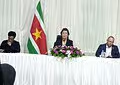





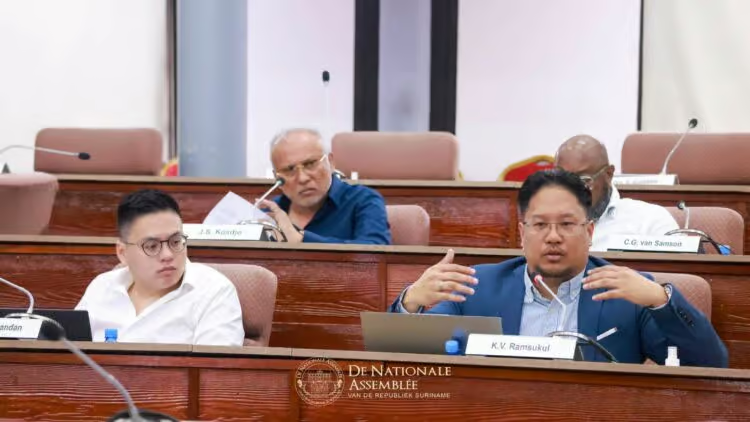


The meeting took place in the context of the parliamentary consideration of the draft laws Supervision of Money Transfer Offices 2024 and Supervision of Payment Service Providers. Both bills are intended to strengthen supervision of financial services and establish clearer rules for businesses offering money transfers and payment services.
Cambio operators concerned about administrative burdens
Brayen Hoever, representative of the Vereniging van Cambiohouders in Suriname, drew attention to the administrative obligations entailed by the new regulations. According to him, practical feasibility for entrepreneurs must be taken into account when establishing licensing requirements.
Hoever also pointed to the importance of clear timeframes for applying for and renewing licences. He also advocated better alignment with international standards and a more explicit inclusion of cyber risks in the legal provisions on risk management.
Mohamed Bhailal, also a representative of the Vereniging van Cambiohouders, expressed concerns about the proposed licensing procedures. He stated that the requirements could cause significant administrative burdens.
Bhailal also raised reservations about the powers of the Centrale Bank van Suriname (CBvS). According to him, the regulations must provide sufficient opportunities to tackle illegal currency exchange activities.
Reliable electronic payment traffic necessary
Andrew Jong, director of Banking Network Suriname N.V. (BNETS), emphasised during the meeting the importance of reliable and well-functioning electronic payment traffic.
According to Jong, banks must be technically well connected to one another, so that consumers can use their payment cards at different payment terminals without problems.
He also drew attention to Suriname’s position within international payment traffic. He pointed to the importance of sufficient national control over the processing of international payments and reliable payment infrastructure.
International transactions and de-risking
Kieran Chong of Southern Commercial Bank addressed possible bottlenecks in the implementation of the draft law on Supervision of Payment Service Providers. In doing so, he pointed to the need to align Surinamese regulations with international standards.
He also drew attention to the consequences that the proposed rules may have for the provision of payment services, including international transactions.
Lindsay Zorg of International Money Transfer (IMT) brought the so-called de-risking to attention. This is a practice in which financial institutions decide to no longer serve certain customers or businesses because of risks they associate with these relationships.
Zorg also requested clarity on the duration of licensing procedures and the assessment criteria applied to applications.
Representatives of HJ Group also took part in the meeting.
New legal frameworks for financial services
The draft law on Supervision of Money Transfer Offices, which was submitted on 26 November 2024, is intended to establish new rules for supervision of money transfer offices. The emphasis is, among other things, on strengthening integrity supervision.
The draft law on Supervision of Payment Service Providers, submitted on 7 March 2025, is intended to create a legal framework for legal entities offering payment services to the public.
With the consideration of both bills, De Nationale Assemblée is working towards further regulation of financial services. The comments by sector representatives highlight various points of attention, including the feasibility of the legislation, administrative burdens and supervision of financial institutions.
Parliamentary consideration
The Commissie van Rapporteurs is chaired by Rossellie Cotino. Committee members Asiskumar Gajadien, Raymond Sapoen, Chuanrui Wang and Michael Marengo also took part in the meeting.
Ameerani Jarbandhan, Ebu Jones and Rabindre Parmessar attended the meeting as observers. The information provided does not indicate when the parliamentary consideration of both bills will be concluded.