




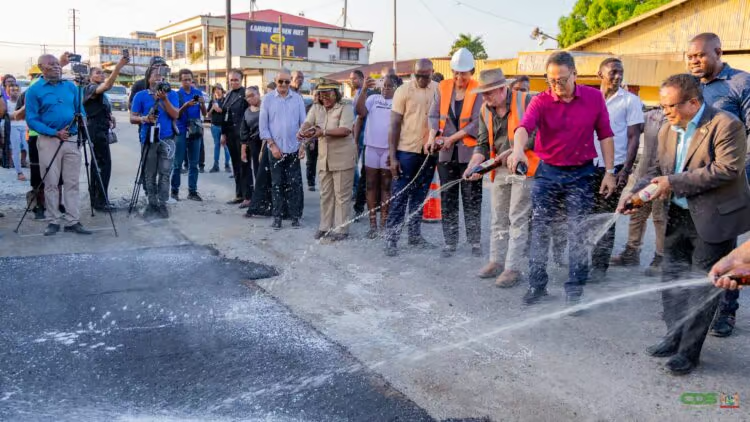


The government officially began implementing a nationwide road-paving programme on Friday, November 6, 2026. President Jennifer Simons gave the starting signal for the work on the Franklynweg in the ressort Latour. In the first phase, 160 kilometres of unpaved roads in Paramaribo, Commewijne and Wanica will be paved. The programme is intended not only to improve the accessibility of residential areas, but also to create new economic and social development opportunities.
The Franklynweg is the first road to be addressed under the programme. In addition to applying an asphalt layer, drainage systems will also be improved where necessary. The street will receive a sidewalk on one side, and speed bumps will be installed near the adjacent schools to increase road safety.
The work will be carried out by Kuldipsingh Infra N.V., while Buro CITE N.V. is responsible for oversight. Among those present at the official launch were Vice President Gregory Rusland, Minister Stephen Tsang of Openbare Werken en Ruimtelijke Ordening (OWRO; Public Works and Spatial Planning), Minister Lalinie Gopal of Jeugdontwikkeling en Sport and District Commissioner Wennys Vijfhoven of Paramaribo-Zuid.
Paving all roads would cost US$ 2.5 billion
According to Minister Tsang, Suriname has approximately 5,000 kilometres of roads, only half of which are paved. An estimated US$ 2.5 billion would be needed to pave the remaining 2,500 kilometres. Given the scale of this investment, the government has opted for a phased approach.
The minister emphasised that roads important for accessibility and economic activities will be given priority. These include connecting roads, neighbourhood roads, bus routes and logistics routes.
“We deliberately do not mention street names, but give priority to unpaved roads, particularly connecting roads, neighbourhood roads, bus routes and logistics routes,” Tsang stated.
President Simons acknowledged that there is a great need for better roads, but pointed out that not all backlogs can be cleared within one year.
“We cannot do everything at once, but we do what we can with what we have. We cannot address the 2,500 kilometres in one year, but we will continue next year, until 2031,” the head of state said.
Better infrastructure must stimulate development
Tsang expects that improving the road network will create new opportunities for residents, entrepreneurs and transport operators. Better roads can increase the accessibility of residential neighbourhoods and facilitate the transport of people and goods.
At the same time, the minister stressed that the sustainability of the investments partly depends on the behaviour of road users and neighbourhood residents. He warned against dumping waste on streets and in drainage canals. Blocked drains can cause flooding during heavy rainfall and affect the quality of the infrastructure.
He also called on motorists to comply with traffic regulations and not use the new asphalt roads as racetracks. He asked residents of other areas to be patient until their roads are addressed.
Attention to safety during the work
Deputy Director of Dry Civil Engineering Works Vikash Moenna stressed the importance of safety during implementation. He called on the contractor to ensure that workers are clearly visible and that the work is carried out responsibly.
He asked neighbourhood residents to take into account the presence of heavy equipment. Parents must ensure that children do not enter the vicinity of the work unaccompanied.
Moenna also pointed out to transport operators that the maximum permitted axle load on the road is eight tonnes. Exceeding this limit can cause damage to the new road surface.
District Commissioner: good roads are a basic necessity
District Commissioner Wennys Vijfhoven welcomed the start of the project. According to her, poor roads, inadequate drainage and overdue maintenance are among the most common complaints residents bring to the districtscommissariaat (district commissioner’s office).
“A good road is not a luxury, but a basic necessity to which every citizen is entitled,” Vijfhoven stated.
She stressed that improving infrastructure is an important step for the liveability of the neighbourhoods. At the same time, she called on residents to take responsibility for their immediate living environment by keeping verges, gutters and drainage canals clean.
With the start of the work on the Franklynweg, the first phase of the paving programme is officially under way. It has not yet been announced which roads will be addressed after this street and within what timeframe the full 160 kilometres will be completed.