
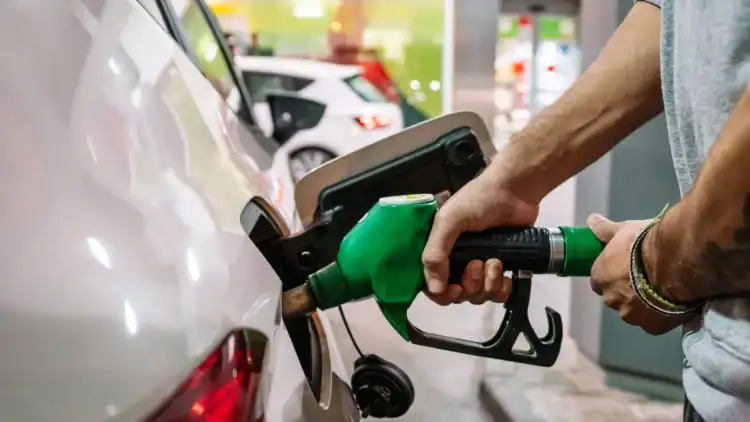


The government of President Jennifer Simons is for the time being maintaining the fuel subsidy that caps pump prices for gasoline and diesel. Although the so-called price cap costs the state approximately SRD 350 million per month in revenue, according to previously presented figures, the head of state considers it irresponsible at this time to abolish the measure.
Simons fears that higher fuel prices will lead to a new wave of price increases in shops, while the government is still insufficiently able to prevent unjustified price increases.
The president said this on Saturday, November 7, 2026, on the programme Kal Aaj Aur Kal of Rapar Broadcasting Network (RBN). According to Simons, it is ultimately inevitable that fuel subsidisation will be phased out, but the government must first be able to absorb the consequences for consumers, businesses and the transport sector.
Price cap in force since March
The government introduced the price cap arrangement on March 18, 2026, to stabilise fuel prices. The reason was sharply rising international oil prices as a result of the war situation in the Middle East.
At the time, maximum prices were set at SRD 53.27 per litre of diesel and SRD 48.32 per litre of unleaded gasoline. The arrangement applied to new fuel shipments from March 18 and did not apply to super unleaded.
When international oil prices exceed the established price ceiling, the difference is absorbed through the so-called Government Take, the government’s share of the fuel price. As a result, the state forgoes part of its revenue to prevent international price increases from being fully passed on to consumers.
The government also decided in April to maintain the prices. Key News reported at the time that the price ceilings for diesel and unleaded would remain unchanged for the time being.
Fuel cap costs state hundreds of millions
The financial consequences of the measure became particularly evident in August. Minister Adelien Wijnerman of Financiën en Planning announced at the time that the fuel cap was costing the government approximately SRD 350 million per month in revenue.
According to the minister, the total amount of lost revenue had risen to approximately SRD 1.4 billion through July. The government was therefore examining various options to phase out the arrangement in whole or in part.
The minister pointed out that an increase in civil servants’ salaries would bring little improvement in purchasing power if consumers were simultaneously confronted with substantially higher fuel prices and rising living costs.
Despite the financial pressure, no final decision was made at that time on ending the arrangement.
Warnings since introduction
That the price cap would be financially difficult to sustain became clear shortly after its introduction. On March 25, Edgar Dikan, coordinator of the presidential Crisisbeheersingsteam (Crisis Management Team), stated that the measure was necessary to protect the economy from inflation, but could not be continued indefinitely.
Key News reported at the time on his warning that the price cap was not sustainable in the long term.
Critical observations also came from the business community. The Vereniging Surinaams Bedrijfsleven (VSB) warned in March of the possible consequences of the fuel policy for public finances, inflation and exchange-rate stability.
A survey among VSB members showed that approximately three-quarters of respondents considered a general price cap risky to very risky. The organisation called for a careful assessment of the economic consequences of the price ceiling.
Simons fears new price increases
According to President Simons, the biggest problem with lifting fuel price controls is that increases at the pump are often used as a reason to raise the prices of foodstuffs and other products.
According to her, shopkeepers regularly implement price increases that cannot be fully justified by the higher fuel costs.
The head of state acknowledges that price controls are still functioning insufficiently to effectively prevent such practices. The government is working to improve oversight, but wants to prevent consumers from being confronted with new price increases in the meantime.
In addition, freeing up the diesel price could lead to higher government expenditure on public transport and school transport. The government would then have to provide more compensation to keep fares affordable.
According to Simons, there are also problems with monitoring in this area. For example, not all transport operators have yet complied with the obligation to put their GPS systems in order, meaning the government has insufficient insight into the implementation of subsidised transport services.
No end date yet for fuel cap
With the latest statement, President Simons confirms that the government will not end the fuel subsidy for the time being. No concrete timetable for the phase-out has been announced.
The head of state has also not provided current figures on the total revenue the government has forgone since the introduction of the price cap in March. The most recently mentioned amount of SRD 1.4 billion related to the period through July 2026.
The government therefore faces the task of protecting the population’s purchasing power on the one hand and limiting pressure on public finances on the other.
For the time being, Simons has chosen to continue supporting fuel prices, until, according to her, sufficient control mechanisms are in place to absorb the consequences of phasing out the subsidy.
Editorial note: The amount of SRD 350 million per month concerns previously reported lost government revenue, not a newly established amount for November. This distinction is important because no current financial accounting is yet available.