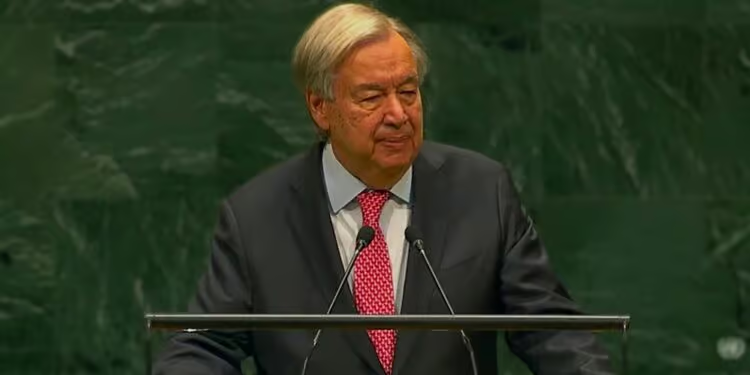
UN Secretary-General António Guterres has called on world leaders to make international agreements on the development and use of artificial intelligence (AI). During his final address to the United Nations General Assembly as secretary-general, he warned on Tuesday that rapid technological developments bring new risks that cannot be managed by individual countries alone.
Guterres spoke during the 81st United Nations General Assembly in New York, where nearly 130 world leaders have gathered. His second term as secretary-general ends on 31 December 2026, bringing to a close a ten-year period at the head of the UN.
According to the UN chief, countries leading the development of artificial intelligence must share more information with one another about new security risks. They must also cooperate in testing and assessing AI systems.
Guterres called for common safety rules and an international framework for managing risks related to artificial intelligence.
He said work must be done on “a multilateral framework for AI risk management”, supported by credible and independent oversight. According to him, technological developments must take place responsibly and additional safeguards must be introduced as AI systems become more powerful.
AI increasingly high on the international agenda
The secretary-general has long advocated international cooperation on artificial intelligence. In 2023, the UN established an advisory body that included representatives of technology companies, governments and academia.
The UN Security Council has also become more explicitly engaged with the risks of AI in recent years. This week, representatives from the technology sector will once again brief the Security Council on the consequences of artificial intelligence for international peace and security.
The discussion includes the possible use of AI in cyberattacks, military systems, disinformation and other applications that may have consequences for national and international security.
Wars and climate change
Guterres did not use his farewell address only to draw attention to artificial intelligence. He also called on world leaders to end armed conflicts and take more action against climate change.
Regarding tensions in the Middle East, he advocated de-escalation and dialogue. He also stressed that humanitarian aid must be allowed to be delivered without obstruction and that international rules on freedom of navigation must be respected.
On climate issues, Guterres reiterated his position that major polluters must bear greater responsibility for the consequences of climate change.
Reform of the United Nations
The UN chief also reflected on the way international institutions function. According to him, the mechanisms for joint international action are increasingly under pressure.
Guterres said that many global institutions still reflect a distribution of power originating from an era that has now largely passed. He therefore again advocated reforms that would better align international institutions with current geopolitical and economic relations.
That discussion is also relevant to developing countries and small states, which have long called for a greater voice within international institutions.
The General Assembly in New York is attended by delegations from virtually all UN member states. Suriname is also taking part in the annual meeting.
Guterres concluded his address with the message that he will continue to commit himself to peace and the principles of the Charter of the United Nations even after leaving the UN.