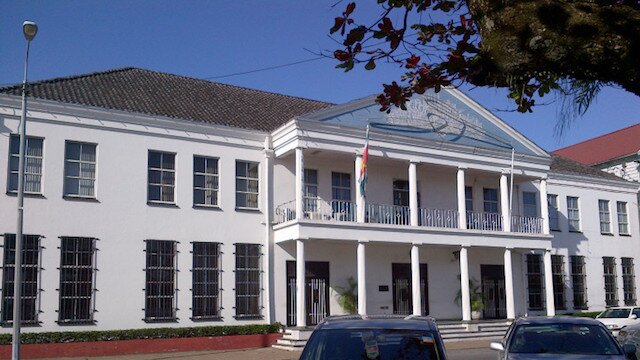
The Simons government wants to accelerate the development of solar energy in Suriname and explicitly involve the business community, investors and financial institutions in the process. A strategic roundtable discussion will take place at Congreshal on Friday, October 30, 2026, aimed at leading to concrete investment projects and agreements on the future energy supply.
President Jennifer Simons will open the meeting. The consultation will focus on sustainable energy and energy security through investments in solar energy. Representatives of the government, energy companies, financial institutions, experts and potential investors will consider the possibilities for expanding solar energy generation in Suriname.
This concerns not only large-scale solar parks, but also solar panels on homes and business premises. Hybrid energy systems will also be considered, in which solar panels are combined with, for example, batteries and other energy sources. Such systems can ensure that essential equipment continues to function during power outages.
Participants will discuss, among other things, financing, technical requirements, concrete projects and partnerships between local companies and foreign investors.
Energy policy has a long history
Attention to sustainable energy is not new. Suriname already has a National Energy Policy Plan 2013–2033, which focuses, among other things, on energy security, access to electricity and the use of renewable energy sources.
During the Bouterse government, the Electricity Act and the law concerning the Energie Autoriteit Suriname (EAS) were adopted in 2016. This created a legal framework for regulation of the electricity sector, oversight and the further development of energy projects.
The legislation also provided for opportunities for private electricity generation and the development of sustainable energy. It also laid the foundation for feeding self-generated electricity back into the grid and attracting private investors through tenders.
The 2017–2021 Development Plan also focused on improving the electricity supply, energy conservation, modernising distribution networks and the use of alternative energy sources. Work was also carried out on preparing an Electricity Sector Plan.
Santokhi government continued reforms and solar energy projects
Work also continued on restructuring the energy sector under the Santokhi-Brunswijk government. In 2021, the government announced that it would adjust electricity tariffs and subsidy arrangements, with the 2016 Electricity Act as the legal basis.
The policy was aimed, among other things, at the financial sustainability of the electricity supply and reducing dependence on government subsidies. The tariff adjustments formed part of a broader reform of the sector.
In addition, several solar energy and electrification projects were implemented or prepared with international support.
For example, a solar power plant with a capacity of 2.3 megawatt peak and battery storage was established in Clarapolder, Nickerie, in June 2022. Earlier, in 2018, a solar power plant with a capacity of 500 kilowatt peak had been commissioned in the Atjoni-Pokigron area.
In 2024, agreements were concluded for new solar energy systems under a project supported by the Inter-American Development Bank (IDB), including installations for Wanhatti in Marowijne and Baku in Brokopondo. Investments were also made in training staff responsible for managing sustainable energy systems in the interior.
These projects show that Suriname has already gained experience with solar energy, but that development so far has consisted of various separate initiatives.
Share of sustainable energy declined despite investments
Suriname’s 2025 report on the Sustainable Development Goals (SDGs) shows that renewable energy capacity increased slightly between 2019 and 2023, from 190 to 193 megawatts. Nevertheless, the share of renewable energy in total installed electricity capacity declined over the same period from 42 to 33 percent.
This was because electricity generation capacity using non-renewable energy sources grew faster. The report also cites dependence on fossil fuels, outdated electricity networks and limited institutional capacity as challenges for the energy sector.
The Energie Autoriteit Suriname has meanwhile worked on an Electricity Sector Plan and a Rural Electrification Plan. These plans are intended to contribute to a better-organised expansion of the electricity supply and a greater role for sustainable energy, with particular attention to the interior.
Simons government already held energy roundtable in June
The October 30 meeting is also not the current government’s first energy roundtable. On June 19, 2026, the Simons government organised a strategic consultation on energy security, investments and cooperation.
Participants in that consultation included EBS, Staatsolie, the Energie Autoriteit Suriname, the Surinaamse Bankiersvereniging and representatives of the business community.
During the meeting, it was agreed that priority should be given to expanding electricity generation, attracting financing and examining necessary adjustments to laws and regulations. The use of future gas production for the energy supply was also discussed.
The government announced at the time that the outcomes would contribute to a Nationale Energie Roadmap 2026–2035, an Energy Action Memo and an Energy Task Force.
The announced solar energy meeting therefore appears to be a further elaboration of the process launched in June.
Implementation and financing will be decisive
Although successive governments have undertaken various policy initiatives, the implementation of a coherent energy policy remains an important point of attention.
In particular, financing new power plants, expanding and modernising the electricity grid, and maintaining existing installations require long-term planning. Account will also have to be taken of the rising electricity demand of households and businesses.
Solar energy can contribute to reducing fuel consumption and diversifying electricity generation. At the same time, investments in battery storage, controllable generation capacity and grid reinforcement are needed to safeguard security of supply when the sun is not shining.
The new roundtable will therefore also address how the plans can be translated into financially viable projects, with clear responsibilities, financing agreements and implementation timelines.
New energy agenda for 2026–2035
The government wants to record the results of the meeting in concrete action points. These are to serve as the basis for an Energy Action Memo, the establishment of a Solar-Energy Task Force and the further development of the Nationale Energie Roadmap 2026–2035.
This should clarify which projects will receive priority, who will be responsible for implementation and how investments will be financed.
For Suriname, ultimately, not only the creation of new policy documents will be important, but above all the extent to which existing and new plans lead to a more reliable and affordable electricity supply.
Experts and representatives of the solar energy sector who wish to participate in the meeting can register via the online registration form. They must provide their name, organisation, expertise and contact details. Participation is only possible after confirmation by the organisers.