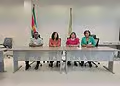
President Jennifer Simons wants cooperation between Suriname and China to be further translated into concrete projects, local employment and better access for Surinamese products to the Chinese market. She stressed this on Monday, 12 October, during a meeting with a Chinese delegation at the presidential palace.
The fourteen-member delegation of the National Committee of the Chinese People’s Political Consultative Conference (CPPCC) is led by Vice-Chairman Bater. The visit took place in the context of fifty years of diplomatic relations between Suriname and China. Minister Melvin Bouva of Foreign Affairs, International Trade and Cooperation and Chinese Ambassador Lin Ji also attended the meeting.
Simons and Bater expressed support for further strengthening bilateral relations. The president emphasised that Suriname attaches importance to the implementation of previously made commitments and agreements.
According to the head of state, there are opportunities to deepen trade and investment relations and expand cooperation between companies from both countries. The development of the offshore oil industry also offers opportunities for further cooperation, she said.
Suriname is seeking partnerships that contribute to economic diversification, technology transfer and local employment. Simons also cited the training of a qualified workforce as an important point of attention, so that Surinamese people can respond to the needs of the changing economy.
Cooperation with China now includes infrastructure, energy, mining, agriculture, healthcare, education and technology, among other areas. The president also wants to promote access for Surinamese products to the Chinese market.
During the meeting, Simons also reflected on the historical and cultural ties between the two countries. She referred to the arrival of Chinese contract labourers and the contribution of the Chinese community to Suriname’s social, cultural and economic development. She further confirmed that Suriname adheres to the one-China principle, which has been a pillar of the relationship since diplomatic relations were established in 1976.
Minister Bouva sees the visit as a step towards a next phase in the cooperation. According to him, an important foundation has already been laid and attention must now be directed towards specific, concrete follow-up steps. The information provided does not further specify which projects will result from this.