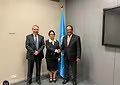





President Jennifer Simons wants Suriname to show a significant increase in the use of solar energy from 2027, particularly among companies and households with high electricity consumption. According to the head of state, it is necessary to reduce dependence on traditional energy sources and strengthen the country’s energy security. The government therefore wants to remove regulatory barriers to enable investments in solar energy.
This emerged on Friday, October 30, 2026, during a strategic roundtable discussion on solar energy at the Congreshal. The meeting, organised at the initiative of the Kabinet van de President, focused on sustainable energy, energy security and investment opportunities. The outcomes are also expected to contribute to the Nationale Energie Roadmap 2026-2035.
International companies show interest in solar parks
During the opening, President Simons announced that over the past year she had heard proposals from at least four international companies that had jointly presented plans for the development of more than 200 megawatts of solar energy capacity in Suriname.
According to the head of state, such investments would not have to cost the government anything in the initial phase. The electricity generated would then be sold to Energie Bedrijven Suriname (EBS).
The implementation of these plans, however, is being hampered by shortcomings in the regulations. Simons stressed that she personally wants to commit herself to putting the necessary legal and administrative conditions in order.
“But as has already been said, the regulations are not in order,” the president stated.
Electricity capacity shortfall could increase further
The urgency of investments in new energy sources was underlined by Sergio Akiemboto, Chief of Staff of the Kabinet van de President.
According to Akiemboto, Suriname is currently facing a shortfall in available electricity capacity of approximately 80 megawatts. If production capacity is not expanded, this shortfall could rise to between 120 and 140 megawatts by 2030.
“These are not non-binding figures that we can discuss. They are not forecasts, but reality,” Akiemboto stressed.
He warned that insufficient available electricity capacity could affect investment decisions, economic growth, production costs and ultimately the prosperity of the population.
Legislation poses obstacle to large-scale investments
Akiemboto pointed out that nearly ten years after the introduction of the Elektriciteitswet of 2016, no large-scale solar energy project has yet been realised through the legally prescribed public tender procedure.
According to him, several necessary implementing regulations have not yet been fully established. Essential frameworks for tenders, permits, connection to the electricity grid and contractual certainty for investors are also lacking.
These shortcomings must be addressed to enable the development of large-scale solar energy projects.
Government wants to make solar energy more accessible to citizens
In addition to large-scale energy projects, President Simons also wants citizens and companies to invest in solar panels more often.
She expressed appreciation for two banks which, according to her, now offer financing options at reasonable interest rates for investments in solar energy.
However, the president believes the government should examine how the financial threshold for households can be lowered further.
“I think the government may still need to help make more provisions for citizens in order to improve that energy threshold, that investment threshold that exists for solar energy,” Simons said.
She wants to see clear growth in the use of solar energy as early as 2027, with particular attention to companies and households that consume large amounts of electricity.
Energy security important with arrival of oil and gas industry
The president also placed the solar energy plans in the context of the expected economic developments in the oil and gas sector.
According to her, Suriname must prevent its future energy supply from becoming too dependent on a single energy source. She referred to international developments affecting oil prices and stressed the importance of the Afobaka hydroelectric power plant for the current electricity supply.
“Wind, water, sun and other forms of renewables and new technologies are things we need to look at,” Simons said.
During the roundtable discussion, the current situation in the energy sector, investment opportunities and cooperation between the government and the private sector were central. The government wants to use the outcomes in the further development of national energy policy for the 2026-2035 period.