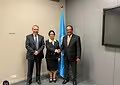



The presentation took place on Thursday, October 29, 2026, at the Kabinet van de President. According to Bob Mangal, vice-chairman of the policy team, better organisation of the sector could ensure that Suriname derives greater economic benefit from its gold reserves.
“If you organise everything properly and involve the people, revenues from gold can genuinely contribute to the development of the state and the people,” Mangal said.
Registration of gold miners and illegal miners
The proposed plan is based on a phased approach, with pilot projects initially being carried out. During these pilots, mining rights holders, owners of machinery and persons currently active in the sector without the required permits must be registered.
The intention is to incorporate these groups, where possible, into an organised and monitorable system. This will also consider the availability of work and residence permits and access to healthcare.
According to Mangal, closer cooperation between the government and gold miners should lead to greater transparency in the sector. This should give the government better insight into both gold production and trade, with the aim of increasing tax revenues and other government income.
Alternatives to mercury use
An important part of the plan is reducing environmental damage caused by gold mining. Under the proposal, the Nationale Milieu Autoriteit (NMA, National Environmental Authority) will be given a role in promoting training and alternative extraction methods.
In small-scale gold mining, mercury is used, among other things, to extract gold from mined material. According to Mangal, there are techniques through which significantly more gold can be recovered without using this harmful substance.
“With mercury, one gets 40% and 70% is lost. There are methods to extract almost 90% from the gold ore without mercury,” Mangal stated during his explanation.
With the introduction of alternative techniques, the working group aims not only to reduce the environmental burden, but also to improve gold-mining yields. The proposed approach should also contribute to more professional working methods and limiting environmental risks.
Also addressing money laundering and terrorist financing
In addition to the economic and environmental aspects, the plan focuses on better control of the gold trade. A clearer and better-regulated system should help Suriname meet international compliance requirements.
This includes, among other things, limiting the risks of money laundering and terrorist financing. According to the working group, registration and oversight should contribute to greater insight into the origin and trading of gold.
First results expected through pilot projects
The plan is to be implemented between 2026 and 2028. During this period, the organisational and legal conditions will be further developed. The pilot projects must then demonstrate how the proposed measures function in practice and what revenues they can generate.
Mangal stated that President Simons responded positively to the presentation. At the same time, he acknowledged that the proposal still needs to be further developed.
“The plan is not perfect, but you need a starting point somewhere. You cannot remain indecisive,” he said.
The working group considers the organisation of the small-scale gold sector a national priority. According to Mangal, Suriname should not rely solely on future revenues from oil and gas, but should also ensure better management of the existing gold sector.
It has not yet been announced when the first pilot projects will actually begin or how much additional revenue the measures could generate for the state.