A collective of eight Surinamese environmental organisations is deeply concerned about the agricultural plan of Braganza Marketing Group N.V. The organisations state that the possible use of more than 34,000 hectares of primary forest for large-scale agriculture could have serious ecological and social consequences.
This concerns the Suriname Agricultural Development Program, through which Braganza aims to increase Suriname’s agricultural production and exports. The strategic plan targets an agricultural export value of USD 4 billion by 2040. This includes considering the involvement of foreign agricultural companies and Mennonite communities.
According to the environmental organisations, however, the plan does not offer a sustainable solution for the development of the agricultural sector. They fear large-scale deforestation, soil depletion, pollution from agricultural chemicals and disruption of water management.
Doubts over economic benefits
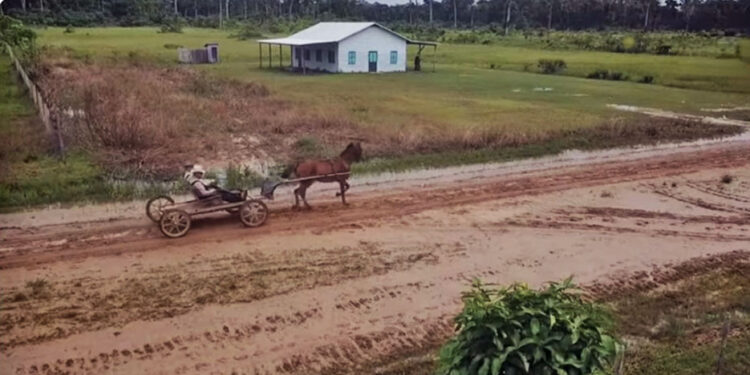
The collective also doubts whether the programme will generate sufficient structural employment for Surinamese people. The organisations refer to experiences in, among other countries, Bolivia, Belize, Peru and Colombia, where Mennonite farming communities, according to them, operate largely in isolation and are self-sufficient.
Local residents there would mainly be employed temporarily for heavy work, including forest clearing. Moreover, a significant portion of the proceeds would be used to purchase machinery, agricultural materials and new plots of land.
The environmental organisations further state that the sandy soils of the Zanderij Formation are unsuitable for the proposed large-scale agriculture. Intensive use of these lands could, according to them, lead to soil degradation and lasting pollution.
Criticism of map material
The accuracy of a map in Braganza’s agricultural vision is also disputed. According to the collective, two Surinamese GIS experts examined historical satellite images and were unable to find the deforestation patterns shown on the map.
The organisations say that both Google Earth images from the period from 1970 through 2020 and recent information from Global Forest Watch do not confirm the straight lines and triangular clearing areas depicted.
They therefore call for full transparency regarding the data used. According to the collective, reliable data must form the basis for decisions on large-scale agriculture and spatial planning.
Risks to climate and existing agriculture
The organisations warn that deforestation does not only affect the area concerned. Changes in water management and the use of fertilisers, pesticides and herbicides could, according to them, also affect agricultural areas further downstream.
They point to possible consequences for biodiversity, water quality, public health and existing agricultural sectors in, among other places, Nickerie, Coronie and Saramacca.
The collective also emphasises the importance of Suriname’s forest for carbon storage, the regional water cycle and the protection of plant and animal species. According to the organisations, large-scale deforestation would also undermine Suriname’s position as a carbon-negative country and potential income from carbon credits.
Alternative revenue models proposed
Instead of large-scale deforestation, the organisations advocate economic activities that preserve the forest. They mention carbon credits, international climate funds, ecotourism and the bioeconomy, among other options.
In the bioeconomy, they say, this could involve scientific research and the sustainable harvesting of medicinal plants, oils and nuts. Ecotourism could also generate income and employment for local communities without destroying large natural areas.
Call to government and parliament
The organisations call on President Jennifer Simons, De Nationale Assemblée (Suriname’s parliament), the Nationaal Ontwikkelingsplatform and the ministries of Landbouw, Veeteelt en Visserij, Grondbeleid en Bosbeheer and Olie, Gas en Milieu to have Braganza’s vision thoroughly reviewed.
According to the collective, local communities must also be given a say before decisions are made on agricultural projects that could affect their residential areas and way of life.
The statement was signed by Wildlife & People Suriname, Tropenbos Suriname, WWF-Guianas, NeoWild, Conservation International Suriname, Amazon Conservation Team Guianas, Suriname Alliance for the Environment and Stichting Ontwikkeling Rurale Gemeenschappen.
A response from Braganza Marketing Group to the organisations’ objections was not included in the press release provided.