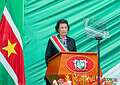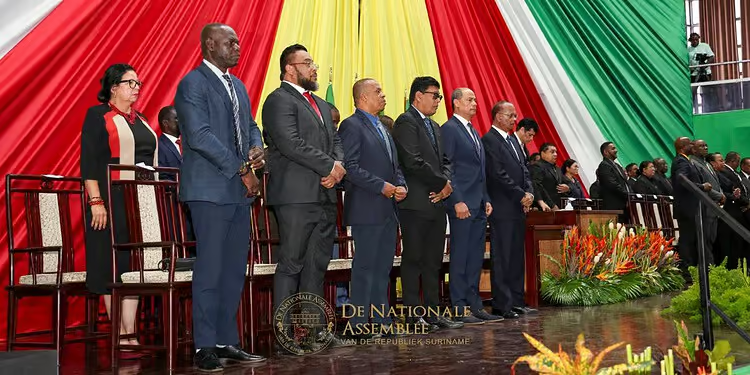
President Jennifer Simons’ annual address and the draft 2027 budget have prompted mixed reactions from parliamentary group leaders in De Nationale Assemblée (Suriname’s parliament; DNA). Several groups see positive starting points in the policy intentions, but emphasise that implementation will be decisive. There are also concerns about the national debt, the budget deficit and the purchasing power of the population.
The parliamentary group leaders responded after the president delivered her second annual address on Wednesday, September 30, at the Congreshal. It addressed, among other things, the economic outlook, opportunities for children in the interior and the protection of vulnerable groups.
NDP parliamentary group leader Rabindre Parmessar considers it positive that Simons extensively addressed the various policy areas. According to him, the financial figures presented show favourable developments. He points to a budget deficit which, according to the figures cited, is declining from around 5 to 4 percent, and an inflation rate of 8.6 percent, compared to more than 10 percent previously.
“That is a positive development,” Parmessar said. He says the figures will be further discussed during the budget debate in DNA.
A20 parliamentary group leader Steven Reyme calls the annual address hopeful. He is particularly pleased with the attention given to the development of all of Suriname. According to him, children in the interior should have the same opportunities as children in the coastal plain.
Reyme also appreciates that the president acknowledges that the economy is still fragile and is cautious with promises. “We must work together to restore this country,” he says. In addition, he describes the annual return of Heritage Month as a positive policy intention.
Implementation and timeline central
VHP parliamentary group leader Asiskumar Gajadien addresses, among other things, the announced preparations for the savings and stabilisation fund. He stresses that cooperation between the government and parliament is needed in this regard. For him, the announcements must now be followed by concrete steps.
“We are now waiting for concrete actions from the president and from the government,” Gajadien said.
PL parliamentary group leader Bronto Somohardjo also places emphasis on implementation. He says he mainly listened for answers to questions that exist in society, such as the affordability of groceries, opportunities for children, better services and the outlook for gold and oil.
According to Somohardjo, the president addressed these issues, but it must become clear when and how the plans will be implemented. “I will not judge her on what she said today, but on its feasibility.”
He appreciates that Simons does not want to make major promises. According to him, the population needs concrete results. Parliament will therefore have to assess whether the government actually implements the announced measures.
Concerns over debt and purchasing power
ABOP parliamentarian Edgar Sampie expresses concern about the financial situation. He refers to a cited national debt of 100.4 percent of gross domestic product, compared with a benchmark of 60 percent. The 4 percent budget deficit also requires additional efforts, according to him.
Sampie states that the high debt limits opportunities for international borrowing. Suriname must therefore invest more in production, according to him. The president’s commitment to work on implementing policy does give him some hope, he says.
BEP parliamentary group leader Ronnie Asabina fears that the population will have to tighten its belt further in the coming year. He points to the budget deficit and the vulnerable economy. According to him, there is still a large gap between society’s expectations and daily reality.
“The government must do everything possible to narrow that gap,” Asabina says. If results fail to materialise, trust could be undermined and social unrest could arise, according to him.
NPS parliamentary group leader Jerrel Pawiroredjo is positive about the outlined prospects and the attention for vulnerable groups. According to him, the government must ensure that people can endure the difficult path that still lies ahead.
At the same time, he stresses that policy intentions must be turned into action. “We will hold the government to everything the president has presented to us here,” Pawiroredjo said.