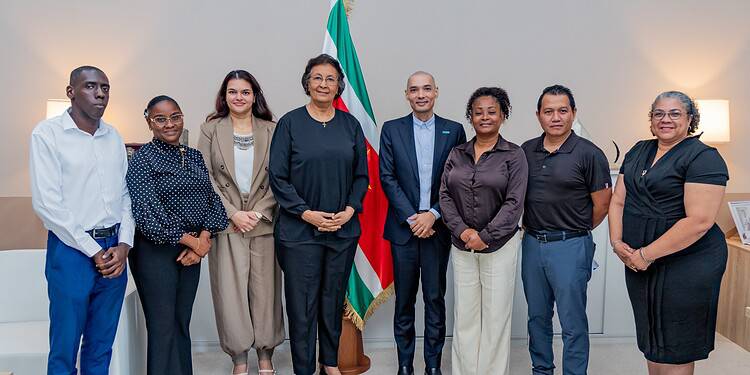
President Jennifer Simons on Monday, September 7, received a draft document containing the results of the education congresses held in April and June. The document is intended to guide the transformation of Suriname’s education system in the run-up to 2035.
The draft document was presented at the Kabinet van de President by the presidential working group Nationaal Onderwijscongres. This working group was responsible for organising the meetings and preparing the final report.
The education congresses aimed to lay the foundation for a long-term vision for education in Suriname. The working group includes representatives of the Kabinet van de President, the ministries of Education, Science and Culture and Youth Development and Sport, as well as UNICEF and the Inter-American Development Bank.
Three key pillars
According to working group member Daniela Rosario of the Ministry of Education, Science and Culture, the education vision for 2035 has not yet been definitively established. However, a process has been mapped out to assess the current situation, needs within education and the desired direction.
The working group has identified three key pillars, linked to various interventions. These still need to be developed into concrete action points. Rosario stresses that the proposed reforms cannot be implemented solely by one ministry or the Kabinet van de President. According to her, broad involvement from society is necessary.
From curriculum-centred to renewed education
An important part of the roadmap to 2035 is the transition from predominantly curriculum-centred education to a more structured and renewed form of education. “We must do that properly in order to be able to speak of high-quality education,” Rosario said. The process examines the education vision, developments in the sector, existing bottlenecks and the strategic direction for the coming years. Work is also under way on an action plan running until 2029.
In addition, the necessary investments are being examined. This includes looking at the cost per pupil and what is needed to realise optimal educational facilities. Good governance, accountability and risk analysis are also part of the reform process.
Involving teachers from the outset
The proposed renewal should ultimately lead to improvements in school readiness, basic skills, inclusion, evidence-based education, quality knowledge transfer, relevant education, lifelong learning and citizenship education. Teachers’ position is also receiving explicit attention. According to Rosario, they must be involved in the process from the outset and further strengthened, so that they can provide optimal education.