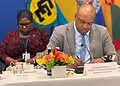
Suriname will receive additional support through a collaboration between LVV and the FAO for the development of livestock farming, improved grassland management and greater youth participation. The project must at the same time contribute to more local food production and less dependence on imports.
The livestock sector in Suriname will receive technical and financial support in the coming years through a joint project of the ministerie van Landbouw, Veeteelt en Visserij (LVV, Ministry of Agriculture, Livestock and Fisheries) and the Food and Agriculture Organization of the United Nations (FAO). The project focuses on modernising the sector, more sustainable grassland management and more strongly involving young people in agriculture and livestock farming.
During a workshop on September 17, 2026, representatives from the agricultural sector were informed about the implementation of the project “Supporting the Surinamese agrifood system through Livestock development and Youth Engagement”, with project code TCP/SUR/4102. The FAO’s public project registry lists a duration from 2026 through 2028 and a total budget of USD 300,000.
LVV Minister Mike Noersalim stated at the opening that Suriname must produce more food itself. Livestock farming in particular offers opportunities, according to him, to reduce imports of, among other things, dairy products and chicken. “Every dollar we spend on a product that we can produce ourselves is one dollar too much,” the minister said.
Suriname’s livestock sector must become more modern and productive
An important part of the project is improving grasslands used for cattle and other livestock. LVV aims to look not only at soil quality, but also at water management, grazing, mechanisation, knowledge and technology. Modern methods must help producers work more efficiently while at the same time limiting pressure on the soil and nature.
According to LVV, good grassland is a basic requirement for a stronger livestock sector in Suriname. During the workshop, policy adviser Ricardo Balai presented an analysis of the current situation. Among the strengths mentioned were the availability of freshwater, sufficient sunlight, suitable soils and C4 grasses.
Young people must bring new knowledge to agriculture
In addition to production and grassland management, much emphasis is placed on young people. Noersalim expressed concern about declining interest in agricultural education and professions. According to him, the sector needs young people who can work with modern technology, data and innovative production methods. “Without young people and their interest, we will not be able to feed ourselves,” the minister stated. LVV has been trying for some time to attract young people to the agricultural sector. Earlier, poultry training courses for young people and beginning farmers were announced, in which participants gained knowledge about, among other things, housing, nutrition, hygiene and business operations.
Without young people and their interest, we will not be able to feed ourselves.
FAO project runs until 2028
FAO representative Gillian Smith participated in the meeting online from Guyana. According to information provided during the workshop, she stated that USD 300,000 and SRD 1 million are available for the programme. The FAO’s public project registry lists TCP/SUR/4102 with a total budget of USD 300,000. The SRD 1 million is not separately mentioned in that registry.
According to LVV, Smith emphasised that cooperation between the government, producers, knowledge institutions, young people and other organisations is necessary to achieve results. The FAO currently has no office in Suriname, but will continue to provide technical support from the region, according to her.
Grassland management offers opportunities and bottlenecks
The analysis discussed during the workshop shows that, alongside opportunities, there are also clear limitations. These included insufficient technical knowledge, limited mechanisation, overdue maintenance and problems with water management. These factors can limit the productivity of livestock farmers and make targeted investments and training necessary.
At the same time, there are opportunities for rotational grazing, demonstration grasslands, biodiversity and silvopastoral systems. Under the latter method, trees and shrubs are combined with livestock farming. This can provide shade for animals, while also making better use of soil quality and available space.
Local production must reduce dependence on imports
The government wants to link the development of the livestock sector in Suriname to a broader commitment to food security and self-reliance. Noersalim pointed out that local production can only grow when entrepreneurs have access to knowledge, financing, technology and market opportunities. He indicated that there are also possibilities for financial support through grants.
The minister stressed at the same time that the government cannot carry the development alone. According to him, producers, educational institutions, youth organisations and other stakeholders must jointly invest in a sector that can provide sufficient, affordable and quality food.
The next step is implementation in practice
The workshop has moved the project further into implementation. In the coming period, it must become clear which training courses, demonstration projects and technical interventions will be set up under TCP/SUR/4102 and how many producers and young people will actually be reached.
For the agricultural sector, it is particularly important that the plans lead to measurable improvements in grassland management, higher production and a greater influx of young entrepreneurs. It is precisely these results that will determine how much impact the FAO project ultimately has on food production and the further development of the livestock sector in Suriname.