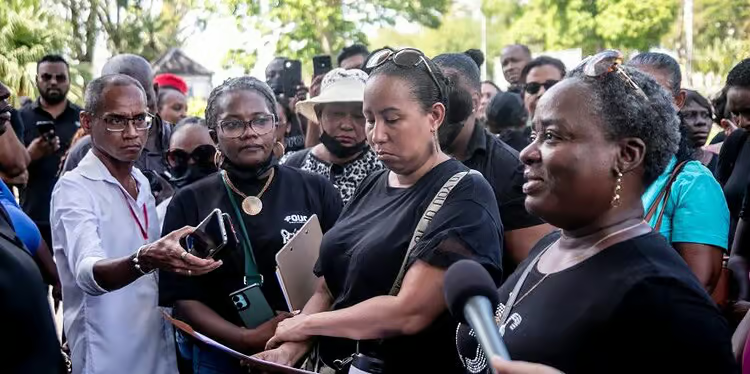
The Syndicate for Education Workers in Suriname (SOS) is not satisfied with the 15 percent salary increase. According to the union, the measure offers insufficient relief for teachers as long as the costs of fuel, food and other basic necessities continue to rise.
The 15 percent salary increase scheduled to take effect at the end of September 2026 for civil servants and equivalent employees cannot resolve teachers’ structural problems, according to the Syndicate for Education Workers in Suriname. SOS states that the increase must be viewed against the backdrop of rising living costs and the financial pressure education workers face on a daily basis.
“Fifteen percent will not solve the teacher’s structural problems. Certainly not when fuel, food and other costs continue to rise,” SOS said in a statement. The union believes that a salary improvement will only have a real effect when it also leads to a lasting increase in teachers’ purchasing power.
According to SOS, the discussion must therefore go beyond just the percentage added to salaries. The organisation wants attention to be paid to broader employment conditions, the financial position of education workers and measures that can prevent employees from leaving the education sector.
SOS considers 15 percent salary increase insufficient
The government and representatives of the trade union movement reached an agreement on Thursday, 27 August 2026, on a general 15 percent salary increase for civil servants and equivalent employees. According to the government’s official announcement, the increase will be processed at the end of September. More about the agreement can be found in the announcement by the Surinamese government.
The consultation on employment conditions has not been concluded with the signed declaration. A joint working group will be established with eight representatives of the government and seven representatives of the trade union movement. That group will have three months to develop proposals for further employment conditions and the associated financial framework. This leaves room for new agreements in addition to the initial salary adjustment.
SOS sees division among education unions
In addition to the level of the 15 percent salary increase, SOS also questions the way education unions presented themselves during the consultations. According to the union, there was public talk of a joint struggle for education workers, while separate representation remained visible at the signing of the declaration.
The official government publication states that Reshma Mangre signed the declaration on behalf of BvL/ALS, while Marisa Meye signed on behalf of the Joint Education Unions. SOS questions how this arrangement relates to the aim of appearing at the negotiating table on behalf of education workers with one joint mandate.
“The teacher deserves one strong voice.”
Union seeks clarity on joint mandate
“If we are truly waging one joint struggle for the teacher, why is that unity visibly broken again at the very moment of signing?” SOS asks. The organisation stresses that, in its view, the criticism is not about personal interests or one specific union, but about the credibility of joint advocacy in education.
According to SOS, the education sector needs a clear and strong voice towards the government. Division among unions can weaken a strong negotiating position, according to the organisation. SOS therefore wants cooperation to be visible not only in statements, joint photos and consultation meetings, but also in decision-making and responsibility for the final outcome.
From a demand of 75 percent to 15 percent
The union points out that considerably higher percentages were mentioned by the education sector during the negotiations. According to SOS, a minimum of 75 percent was put forward as a first step. Against that background, the organisation believes that the final 15 percent salary increase raises questions about the room for negotiation and the joint strategy of the education unions.
SOS believes education workers should be able to clearly see how the achieved result relates to the demands previously expressed. The union therefore expects representatives to explain not only what has been agreed, but also which issues remain open and which concrete improvements are being pursued over the next three months.
Purchasing power remains central to wage negotiations
For SOS, a nominal salary increase is insufficient when price increases erode a large part of that improvement. Higher spending on fuel, food, transport and other daily costs may mean that teachers experience hardly any additional financial room despite a higher salary, according to the organisation.
The 15 percent salary increase must therefore be linked to a broader discussion on purchasing power and provisions, according to the union. The government has previously indicated that the wage negotiations take into account the State’s financial and economic capacity. At the same time, what remains important to the union is what the final agreements will mean in practice for education workers and their families.
Departure of teachers remains a concern
Another important point in SOS’s statement is the departure of teachers. The organisation warns that the education sector will continue losing staff if the financial position, employment conditions and circumstances are insufficiently attractive. According to SOS, the salary discussion is therefore directly linked to schools’ ability to retain sufficient staff.
When experienced teachers leave, this can have consequences for continuity within schools and for the pressure on the staff who remain, according to the union. SOS therefore believes that the upcoming talks should not focus exclusively on a percentage on the payslip, but also on measures that make the profession more attractive and sustainable.
The next three months will be important
According to SOS, the next three months are not a period in which education unions can afford further division. Now that the joint working group must develop proposals, the organisation expects representatives of education workers to establish clear priorities and jointly indicate which results they still want to achieve.
According to SOS, genuine cooperation means that unions sit at the table together, carry a joint mandate, negotiate jointly and also jointly take responsibility for the outcome. The union states that the name “Joint Education Unions” must therefore become visible in practice through one strategy and a clear line towards the government.
Consultations on employment conditions continue
Key News previously reported that civil servants will receive 15 percent more salary at the end of September and that consultations on further employment conditions will continue. The joint declaration therefore does not constitute a final agreement on all outstanding issues.
For teachers, the main question remains what will follow after this initial 15 percent salary increase. The work of the joint working group will have to show whether additional agreements will be made on income, purchasing power and employment conditions. SOS makes clear that it will also closely monitor in the coming period the extent to which the education unions actually act as one bloc.