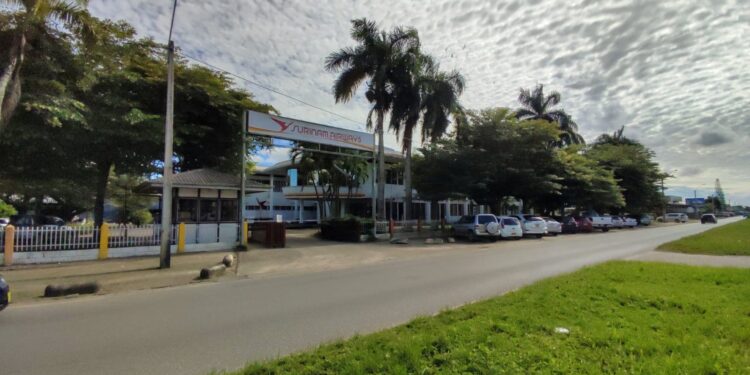
SLM officially turns 64. But behind the national pride, questions are mounting about debt, state support, flight problems and governance. The anniversary therefore calls less for champagne and more for an honest assessment of its future.
On 30 August 2026, Surinamese Luchtvaart Maatschappij officially turns 64. SLM after 64 years is a milestone that invites congratulations, but above all an uncomfortable question: what remains after more than six decades of the national pride that was meant to connect Suriname with the world?
The history of SLM began with ambition. The idea for a Surinamese airline emerged in 1953, domestic flights began in 1955 and the airline was officially established on 30 August 1962. International operations followed from 1964. In November 1975, the Mid-Atlantic connection to Amsterdam was introduced. The history published by Surinam Airways itself shows how deeply the airline became intertwined with Surinamese aviation.
That historical significance is not in dispute. For Surinamese people and the diaspora, SLM became part of family visits, trade, tourism and national identity. The only question is whether history is sufficient reason to keep a company alive that has been under financial and operational pressure for years.
SLM after 64 years: millions in support without a complete financial picture
That is where the biggest problem begins. At the end of 2025, management acknowledged that the latest financial statements date back to 2015/2016. In August 2026, Minister of Finance and Planning Adelien Wijnerman said that SLM still receives around USD 2 million per month from the state, while annual reports remain unavailable. The ministry now wants to formalise that support as a loan, so that repayment arrangements can be made. Key News previously reported extensively on this state support for SLM.

That sounds more businesslike, but it does not change the fundamental question: how much money is the state still willing to put into SLM before it becomes clear what society receives in return? A state-owned company that needs public funds cannot lag behind for years in financial accountability while asking for trust at the same time.
SLM’s actual debt remains a crucial question
There has also been uncertainty for months about the actual debt position. Earlier this year, Minister Raymond Landveld stated that the debts may be considerably higher than previous plans had suggested to the government. The Supervisory Board now has a new financial report. The total amount is known internally, but has not yet been made public because the figures are still being analysed and validated.
That is precisely where the problem lies. When taxpayers are asked to keep a national company afloat, this should be matched by maximum transparency. Without current figures, it is difficult to determine whether SLM is being saved or merely pushing new obligations into the future.
National pride is not a licence for unlimited millions in support.
Vulnerable operations undermine passengers’ confidence
The operational reality does not make the picture any more reassuring. SLM has become largely dependent on leased aircraft and foreign operators. A wet-lease arrangement is used on the Paramaribo-Amsterdam route. The Airbus A340 operated by Universal Sky Carrier experienced several disruptions in recent months. According to recent reports, SLM intends to switch to a Boeing 777 operated by Eastern Airlines for this route from mid-September.
Regionally, problems also arose with ACMI partner Global X. At the end of August, SLM acknowledged that the practical implementation differed in certain respects from what had been agreed in writing. The airline therefore wants to work with two operators while also returning its own aircraft, PZ TCX, to service as soon as possible. This should reduce dependence on external capacity.
European safety list worsens reputational problem
An airline primarily sells reliability. When flights are regularly changed, delayed or cancelled, SLM not only loses revenue, but above all trust. And in aviation, trust is harder to buy back than a leased aircraft.
A second reputational problem is compounded by this. Since June 2025, all airlines certified by Suriname have been on the European Air Safety List due to shortcomings in national oversight. Suriname remained on the list in the European update of June 2026 as well. SLM can continue serving Amsterdam through an approved foreign operator, but it remains damaging to its image that it cannot do so under its own Surinamese certification.
Problems predate the current management
It would be too easy to place all the problems at the feet of the current management. SLM’s crisis did not begin in 2026. Successive governments, management teams and supervisory boards made decisions on fleet, personnel, financing and governance. Recovery plans followed one another, but structural problems continued to recur.
That is why criticism in De Nationale Assemblée is becoming increasingly sharp. Parliamentarian Mahinder Jogi recently openly asked whether it still makes sense to retain SLM and demanded an explanation for approximately USD 25 million in state support over thirteen to fourteen months. A few days later, Vice President Gregory Rusland said the government had reached a decisive point and that support could not continue without an evaluation. The discussion is therefore no longer only about saving the airline, but about the conditions under which saving it remains justifiable.
SLM’s future requires tough choices
Yet closing SLM is not a simple solution. Suriname has a large diaspora, tourism ambitions and economic interests in the Caribbean, North America, South America and Europe. A national airline can have strategic value. But strategic value is different from a blank cheque. If the state wants to retain SLM, it must become clear which routes are profitable or necessary, how many staff members are required, what fleet is suitable and what partnership or private capital is needed.
Governance must also be removed from the political sphere, because we have all seen what politics has done to SLM. An airline cannot function if senior positions, oversight and strategic choices repeatedly become subjects of political conflict or administrative instability. The recent discussion surrounding the Supervisory Board, including conflicting reports about the position of Supervisory Board chairman Marlon Telting, does not help restore confidence. SLM needs demonstrable aviation expertise, financial management and directors who can be held accountable for measurable results. And that is what has been lacking time and again when looking back at all appointments within SLM. The fact that an appointed person has political links is not necessarily so bad. What matters is whether they can do the job, and this has often fallen short.
No nostalgia, but accountability
After 64 years, SLM therefore deserves not a nostalgic birthday story, but a mature decision. The national carrier has literally connected Suriname with the world for decades. That past deserves respect. But respect for the past must not become a licence to finance the future without clear conditions.
The real question is no longer whether Suriname loves SLM. The real question is what kind of SLM Suriname can still afford, what performance must accompany new state support and whether politicians are finally prepared to conduct that debate using verifiable figures rather than sentiment.