Indigenous organisations are once again opposing the Wet Bescherming Woon en Leefgebieden. Both VIDS and the Inheems Kollektief Suriname state that temporary protection around villages cannot replace recognition of collective land rights.
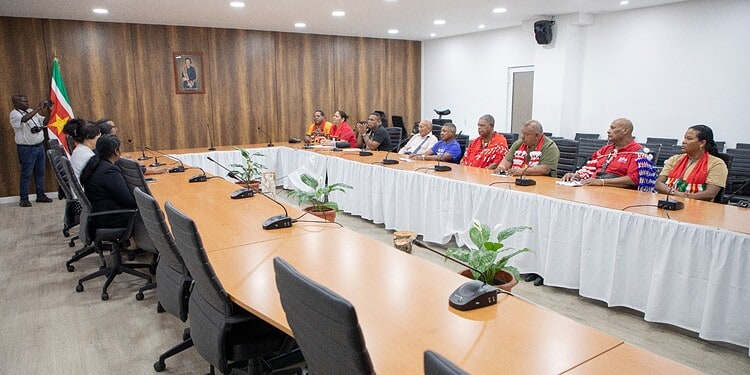
The Vereniging van Inheemse Dorpshoofden in Suriname, VIDS, has once again formally objected to the promulgation of the Wet Bescherming Woon en Leefgebieden. The Traditioneel Gezag (Traditional Authority) met in Paramaribo on 28 and 29 August 2026 and concluded after consultations that, according to the village chiefs, the law offers insufficient protection. The resolution has now been submitted to the Kabinet van de President.
That position closely aligns with the message issued by the Inheems Kollektief Suriname, IKSur, on 9 August. IKSur also states that protection of a limited area around a village does not resolve the fundamental issue. The organisation calls for legal recognition, demarcation and protection of the full traditional territories.
The government sees the function of the law differently. According to the Kabinet van de President, the arrangement is intended as temporary protection until final legislation on land rights is established. Within a radius of five kilometres around village centres, new logging, gold and sand extraction, mining and large-scale agricultural concessions, among other things, would not be permitted. The government has stressed that the measure is not intended to replace the land rights issue.
Wet Bescherming Woon en Leefgebieden insufficient according to organisations
For VIDS and IKSur, an important problem lies precisely in that geographical limitation. According to both organisations, traditional living areas do not end just a few kilometres outside a village centre. Communities use forests, rivers and other areas for hunting, fishing, agriculture, medicinal plants and cultural activities. VIDS also notes that communities have already mapped their traditional territories, but that, according to the organisation, these maps have not been sufficiently taken into account.
In its latest resolution, VIDS refers to protection zones of five or ten kilometres and warns that these do not correspond with the areas communities have historically used. IKSur had earlier also stated that protection within five kilometres cannot be equated with recognition of a traditional territory. This contradiction was also evident in earlier Key News reporting on the Wet Bescherming Woon en Leefgebieden.
Collective rights versus state domain land
A more fundamental objection concerns the legal status of the land. VIDS states that the ancestral territories of Indigenous peoples must not be treated as ordinary state domain land. According to the organisation, the original peoples have collective ownership rights over their traditional territories and Surinamese legislation must be brought into line with this.
Both organisations fear that the temporary arrangement could perpetuate a situation in which the state remains the legal owner, while Indigenous communities receive only limited protection. VIDS argues that third-party rights previously issued may remain in force under certain conditions. According to the organisation, this would mean that certain existing rights are more strongly protected than the collective rights of the original inhabitants, which have not yet been legally recognised.
According to the organisations, protection without recognition does not resolve the land rights issue.
Unknown Staatsbesluit raises new questions
VIDS also objects to the fact that the final designation of areas must take place through a Staatsbesluit (State Decree). The organisation says it has requested its contents, but does not know them. According to the Traditioneel Gezag, communities therefore cannot be expected to agree to an arrangement whose important implementation component is not yet clear.
There are also concerns about monitoring and enforcement. VIDS points to previous land allocations and states that a legal protection zone has little significance when effective oversight is lacking. The organisation also fears that the system effectively confines Indigenous communities to small areas, while land outside the designated zones remains available for other activities.
FPIC and Kaliña Lokono central to opposition
Another similarity between the two statements is the emphasis on Free, Prior and Informed Consent. According to IKSur, Indigenous communities were not sufficiently involved in a meaningful manner in the development of the arrangement. VIDS likewise states that mentioning FPIC in the law is insufficient if, according to the organisation, the principle was not fully applied in the process surrounding the law itself.
The organisations also explicitly refer to the Kaliña and Lokono judgment of the Inter-American Court of Human Rights from 2015. The case concerned, among other things, the legal recognition of collective legal personality and the right to collective ownership of traditional territory. Documents on the case are available through the Inter-American Court of Human Rights. ([Inter-American Court of Human Rights][2])
Environment and position of land defenders
VIDS also links the discussion to environmental problems. In its resolution, the organisation refers, among other things, to the situation around the Saramaccarivier and Lawarivier and states that activities outside a protection zone can still have consequences for communities within that zone. According to VIDS, not only the distance from a village centre is therefore important, but also protection against activities taking place elsewhere that affect rivers, forests or ecosystems.
IKSur extends the discussion further to the position of Indigenous land defenders. The organisation states that persons who stand up for their land and living environment are prosecuted and convicted, while legal recognition of collective rights, according to IKSur, continues to fall short. IKSur therefore calls not only for suspension or withdrawal of the law, but also for the actual application of international human rights standards.
Temporary protection clashes with full recognition
The combination of both positions shows that the discussion has now gone beyond the question of whether five kilometres is sufficient. The core of the conflict lies in the question of what legal status the traditional territories will ultimately receive. The government sees the law as a temporary brake on new concessions. The Indigenous organisations fear that a temporary solution could instead establish a weaker legal position.
VIDS therefore explicitly asks President Jennifer Simons not to promulgate the law. IKSur had earlier called for the arrangement to be withdrawn or suspended and for work to first be done on full recognition of collective rights. Both organisations say they want peaceful dialogue and legal solutions, but make clear that they will not support an arrangement that, according to them, amounts to a deterioration of existing internationally recognised rights.
With the submission of the VIDS resolutions, the issue now once again lies squarely with the government. The Kabinet van de President has confirmed that the documents have been received. ([Government of Suriname][3]) The next political question is whether President Simons will proceed with promulgating the Wet Bescherming Woon en Leefgebieden, have the arrangement amended again, or first return to the table with the Traditioneel Gezag.