

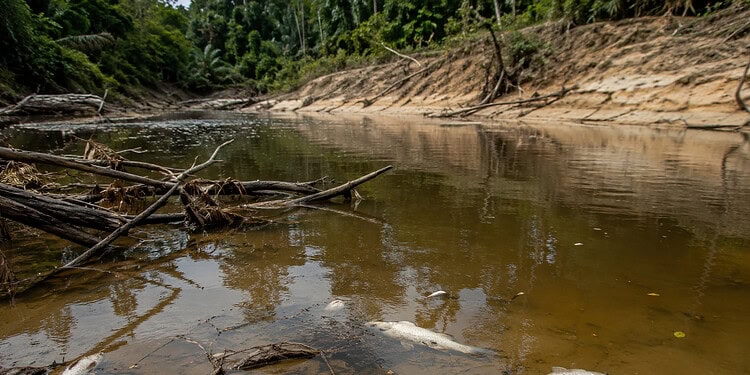


After more than four months of uncertainty about water quality, communities along the Saramacca River can use the river water again. De Nationale Milieu Autoriteit (NMA, National Environment Authority) announced on Wednesday, November 4, 2026, that recent research results show a significant improvement in water quality.
This brings an end, after 131 days, to the urgent precautionary advice not to use the river water. However, the warning against consuming predatory fish remains in force due to the possible accumulation of mercury.
The water contamination came to attention at the end of June 2026 after a mass fish die-off was observed at the Moeroekreek, north of the Indigenous village of Pikin Saron. On June 26, the NMA warned communities along the upper reaches of the Saramacca River not to use river water for drinking, food preparation and other household purposes for the time being.
Key News reported at the time on the NMA warning following the large-scale fish die-off at the Moeroekreek. Residents were also advised to avoid direct contact with the water as much as possible and not to consume or sell dead or sick fish.
Research confirmed presence of harmful substances
The initial investigations yielded mixed results. At the end of June, concentrations of cyanide and mercury were found in water samples which, according to the NMA, were below the standards applied. At the same time, elevated levels of, among others, iron, aluminium and manganese were measured.
In an earlier article on the research results in the Boven-Saramacca area, Key News reported that further investigation was considered necessary before the river water could again be declared safe.
At the end of August, the seriousness of the situation became clearer. The NMA then announced that research had demonstrated chemical substances, including cyanide and heavy metals, in water and fish from the area.
The authorities also investigated a possible link to gold-mining activities. According to the government, the research findings pointed to the area around the Moeroekreek and possible activities on or near a concession held by state mining company Grassalco.
The government announced that it intended to formally hold the company liable for the damage. The NMA also advocated stricter supervision of gold-mining activities and the temporary suspension of certain work in risk areas.
Key News previously reported on this in an article on the NMA’s proposal to temporarily suspend gold-mining activities due to the contamination.
Residents complained about inadequate information
The contamination affected communities that depend on the river for their daily livelihood. In addition to concerns about water availability, uncertainty arose over the safety of fish and other food sources.
Communication from the government also led to criticism. On September 30, Key News reported that the community of Gran Kreek had only been officially warned about the contamination months after the first reports.
Kapitein Angelique Palmtak at the time expressed her dissatisfaction with the late provision of information and the declining trust in the government. She had already advised residents, on her own initiative, to be cautious about swimming, fishing and using creek water.
In the article on the late warning to Gran Kreek, Palmtak stated that her trust in the government had declined considerably.
Minister Brunings had already announced improvement
On October 21, Minister Patrick Brunings of Olie, Gas en Milieu (OGM, Oil, Gas and Environment) said that, according to preliminary research results, the contamination appeared to have largely disappeared.
Key News reported on October 22 that the minister had received positive signals from recent water-quality measurements at various locations along the river. The official research results had yet to be announced at that time.
The article in which Minister Brunings indicated that the contamination of the Saramacca River appeared to have disappeared made clear that the government was anticipating a swift improvement in the situation.
This positive development has now been confirmed by the NMA.
Cyanide no longer detected in samples examined
The new research results are based on water samples taken in September and October 2026 by the NMA in collaboration with the Surinaamse Waterleiding Maatschappij (SWM, Suriname Water Supply Company).
According to the environmental authority, concentrations of arsenic, cadmium, mercury and lead are considerably lower than in previous investigations. In addition, no free cyanide was detected in the water samples examined.
Based on these measurement data, the NMA concludes that the river water can currently once again be safely used by communities along the river.
However, the authority did not include specific measurement values or a comparison with the safety standards applied in its announcement. It also does not separately indicate whether untreated river water is suitable for direct consumption as drinking water.
Warning for predatory fish remains in force
Although the river water has once again been declared safe for use, the NMA continues to warn against eating predatory fish from the river.
Predatory fish are high in the food chain and can accumulate elevated concentrations of mercury in their bodies. As a result, fish consumption may continue to pose a health risk, even when concentrations of harmful substances in the water have declined.
The NMA is therefore preparing a separate study into the safety of fish consumption. From the second week of November, fish samples will be collected every quarter.
Het ministerie van Landbouw, Veeteelt en Visserij (LVV, Ministry of Agriculture, Livestock and Fisheries) will be responsible for sample collection, while the Viskeuringsinstituut (VKI, Fish Inspection Institute) will conduct the laboratory analyses.
Another six months of intensive monitoring
The NMA stresses that the improved water quality does not mean that supervision will end. A multidisciplinary working group of government and health agencies will continue to closely monitor the situation over the next six months.
The communities involved will be regularly informed about new research results and any changes in environmental quality.
With the announcement of November 4, the advice not to use the river water comes to an end after more than four months. However, concerns about possible sources of contamination, food safety and the effects of long-term exposure to harmful substances remain subjects for further research and monitoring.