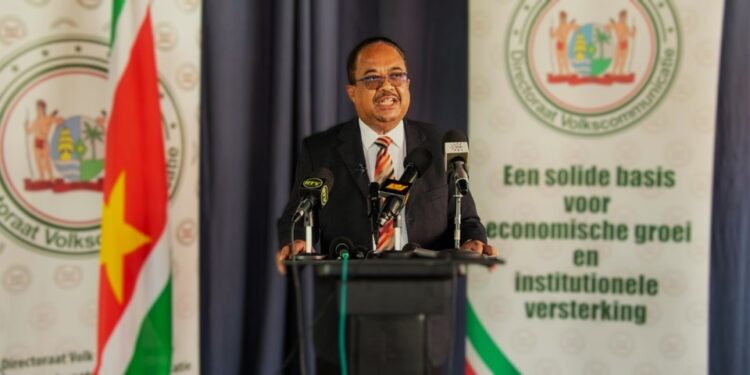
Vice President Gregory Rusland says the government has reached a decisive point regarding the future of Surinam Airways. According to him, financial support cannot continue without evaluation, and clear choices must now be made.
Vice President Gregory Rusland made it clear on Wednesday, ahead of the Council of Ministers meeting, that the government is once again taking a critical look at SLM financial support and the survival of the national airline. “We cannot continue like this, or we continue, but what actions need to be taken in order to continue?” Rusland said.
According to Rusland, the government is holding discussions on the course to be followed with Surinam Airways. He stressed that the current government inherited an existing situation and therefore cannot simply abruptly halt previously implemented policies. At the same time, continuity does not mean, in his view, that existing arrangements must be continued indefinitely.
The Vice President stated that, after evaluations, a point comes when tough decisions become necessary. According to him, that moment has now arrived. “We are now at that point, and discussions within the government about SLM are continuing,” Rusland said. He did not disclose which specific options are currently being discussed.
SLM financial support central to government consultations
Rusland’s statements come shortly after Minister of Finance and Planning Adelien Wijnerman announced that the state is still supporting SLM every month with approximately USD 2 million. The support is intended to keep the airline’s operations running, but according to the minister, the government wants to move away from a situation in which funds are provided without clear repayment arrangements.
Wijnerman said the intention is ultimately to formalize the amounts provided in a loan agreement between the state and SLM. “That money is being provided, but in time there must be arrangements to put the amount into a loan agreement with SLM,” she stated. According to the minister, it is explicitly intended that the government will ultimately recover the funds provided.
The government faces a choice between continued support and far-reaching measures at SLM.
Loan agreement must set out conditions
A future loan agreement must provide greater clarity on the amount officially classified as a loan, the method of repayment and the conditions under which further financial support may be provided. It will also have to determine what obligations the airline will have towards the state when new funds are made available.
Wijnerman has not yet disclosed details on the term, interest rate and repayment conditions. The Ministry of Finance and Planning previously reported that consultations are being held with SLM on how support should be continued. The government stresses that financial contributions cannot continue indefinitely without concrete agreements. More can be read on the website of the Surinamese government.
Previous support for SLM already a subject of debate
Key News previously reported that the monthly financial support of approximately USD 2 million is continuing, despite the earlier intention to phase out support for the state-owned company. The debate therefore concerns not only the airline’s operational survival, but also the question of how much financial room the state still has to continue supporting SLM. Also read the earlier article by Key News on the monthly support for SLM.
A contribution of USD 2 million per month represents a substantial amount for state finances. If such a level of support were maintained for twelve months, it would amount to approximately USD 24 million. This is precisely why pressure is growing on the government to clarify what results are expected in return for the financial support and what improvements are expected from the airline.
Previous loan shows that conditions are possible
The financial relationship between the state and SLM already includes examples of formal loan arrangements. The 2025 annual report of the Court of Audit of Suriname lists a loan agreement concluded on June 24, 2024, between the state and SLM for an amount of USD 2 million. The documents received included, among other things, a financial analysis, monthly financial reports, a repayment plan, a business plan and projections of financial results.
That earlier agreement shows that financial support for the state-owned company can be linked to reporting and repayment. For the current discussion, the key issue is what new conditions the government wants to attach to future support and how strictly compliance with them will be monitored. The government has not yet announced whether a new agreement will contain similar reporting obligations.
Rusland wants to link evaluation to tough decisions
Rusland made it clear that the government does not want to view SLM solely from the principle of policy continuity. According to him, an evaluation must determine whether continuation is justified and, if that option is chosen, what actions are needed to keep the airline viable. This increasingly links the discussion about SLM to conditions, performance and financial responsibility.
The statements indicate that the government is not only considering whether SLM should continue to receive support, but also how the state-owned company should operate in the future. Its financial position, operations and the extent to which the airline can meet its obligations all play an important role.
Future of national airline remains uncertain
As the national airline, SLM holds an important position in connecting Suriname with foreign countries and is also significant for travellers from the Surinamese diaspora. At the same time, structural financial support places pressure on the government, especially when no final agreements yet exist on repayment and the conditions for further financing.
The government will therefore have to determine what outlook it sees for the airline and what performance is needed to justify further support. Rusland’s remarks make clear that a decision cannot be postponed indefinitely. The upcoming discussions within the government will have to show whether SLM can continue under revised conditions, which reforms are needed and how much financial room the state is willing to make available for that purpose.